A Fuller Picture of the Story
The Hilton story quickly gained national attention when the official DHS X account posted screenshots of the emails they received from a hilton.com email address canceling their room reservations, captioned: “When officers attempted to book rooms using official government emails and rates, Hilton Hotels maliciously CANCELLED their reservations. This is UNACCEPTABLE. Why is Hilton Hotels siding with murderers and rapists to deliberately undermine and impede DHS law enforcement from their mission to enforce our nation’s immigration laws?”
With responses to this post – both wildly positive and wildly negative – pouring in, Hilton made a statement to Fox News, saying: “Hilton hotels serve as welcoming places for all. This hotel is independently owned and operated, and the actions referenced are not reflective of Hilton values. We are investigating this matter with this individual hotel, and can confirm that Hilton works with governments, law enforcement and community leaders around the world to ensure our properties are open and inviting to everyone.”
As of April 2026, the Everpeak Hospitality website remains inactive minus a display message reaffirming their commitment to “welcoming all guests and agencies” and emphasizing the inconsistency of “this matter” with their company policy.
How could Hilton – the owner of the Hampton Inn brand – deflect responsibility so easily? The answer: franchising. Under a franchisor-franchisee relationship, a company with a strong business model and industry expertise (the franchisor) is paid by an independent business owner (the franchisee) to operate under the franchisor’s brand. Thus, “franchisees essentially have a framework for making their franchise location a success, but control the day-to-day operations independently.” Hilton – the franchisor – had an agreement with Everpeak Hospitality – a limited liability company (LLC) – to franchise the Lakeville Hampton Inn, and Everpeak remained the independent owner and operator of the specific property.
Hilton provided Everpeak’s statement to Fox in the early days of the controversy as well: “Everpeak Hospitality has moved swiftly to address this matter as it was inconsistent with our policy of being a welcoming place for all. We are in touch with the impacted guests to ensure they are accommodated. We do not discriminate against any individuals or agencies and apologize to those impacted. We are committed to welcoming all guests and operating in accordance with brand standards, applicable laws, and our role as a professional hospitality provider.” Upon the release of this statement, a DHS assistant secretary posted on X, writing: “I wonder how Everpeak Hospitality has “moved swiftly to address this matter” when @DHSgov and @ICEgov haven’t heard anything from them?”
Conservative influencer Nick Sorter then visited the hotel, posing as a DHS officer, and recorded a video requesting rooms under a special DHS government rate. The front desk clerk responded that the hotel’s policy was not to accept ICE or DHS on the property as per their management and ownership, and when questioned about whether the policy had changed, affirmed that he had just spoken to the owner of the building and had not been told about a protocol shift.
Hilton made yet another statement to Fox News: “The independent hotel owner had assured us that they had fixed this problem and published a message confirming this . . . A recent video clearly raises concerns that they are not meeting our standards and values. As such, we are taking immediate action to remove this hotel from our systems. Hilton is — and has always been — a welcoming place for all. We are also engaging with all of our franchisees to reinforce the standards we hold them to across our system to help ensure this does not happen again.”
In a matter of days, Hilton had torn down the Hampton Inn sign and removed the Lakeville property from the Hilton online reservation system. As of April 2026, the Everpeak Hospitality website remains inactive minus a display message reaffirming their commitment to “welcoming all guests and agencies” and emphasizing the inconsistency of “this matter” with their company policy.
Questions remain regarding how far up the chain of command the decision to refuse service to immigration officials went. The hotel employees are understandably avoiding the press due to intense attention from the full breadth of the political spectrum. It is unclear whether the front desk clerk that held the line in person when confronted with a supposed DHS official was reflecting the position of the owner or not. It remains unknown whether the employee(s) who sent the emails to DHS and/or refused service in person remain employed, or how exactly this entire situation impacted the hotel’s business.
Regardless, the immediate capitulation by both Hilton and Everpeak reflects broader trends in corporate power and the prioritization of profit over values. At the same time, the courage demonstrated by the unnamed employees can serve as an inspiration for holding true to one’s values despite potential for personal consequences.
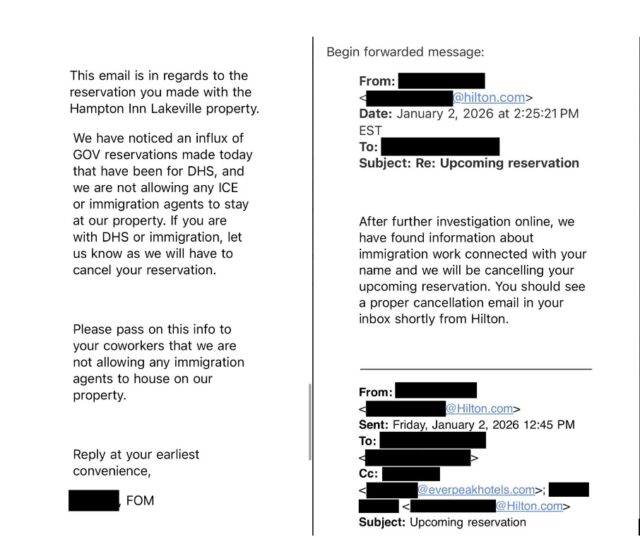
The emails from hilton.com addresses to government addresses, as per DHS’s X post.
Corporate Influences
What explains Hilton and Everpeak’s knee-jerk appeasement of the Trump administration? The concept of shareholder primacy – corporate law’s most foundational norm – offers the best explanation. Shareholder primacy imposes upon corporate boards of directors the duty to prioritize the interests of the corporation’s shareholders. Consequently, shareholder value must be maximized before considering other interests, and there is no requirement that non-shareholder interests be considered at all. Given that uplifting non-financial, social interests generally takes resources, profit maximization does not simply rank above other interests – it comes at their expense.
Though dedication to this principle has ebbed and flowed throughout history, primarily ebbing in particularly heightened moments of societal injustice in which corporations wholly ignoring non-shareholder interests would threaten these corporations’ legitimacy and even existence, it is firmly entrenched in today’s corporate landscape.
Hilton’s previous public stances regarding ICE highlight this ebb and flow. In 2020, the coronavirus pandemic and the Black Lives Matter movement in the wake of George Floyd’s murder by police – also in Minneapolis – returned national attention and anger to the pervasive racial and economic injustices rooted in basically every facet of life in the United States. 2020 can be viewed as a disruptive moment of ebb during a larger arc of flow that resulted from the perfect storm of visible injustice and ensuing unrest. Consequently, corporations faced heightened pressure to appear “woke” at a time when these perceptions increasingly altered consumer behavior and potentially threatened corporations that did not acknowledge current, hard-to-ignore issues.
In July 2020, Hilton released a public statement confirming that another Hampton Inn franchisee had accepted reservations from a private contractor working for ICE for the purpose of holding detained migrants as they were moved between locations. “This is not activity that we support or in any way want associated with our hotels,” Hilton wrote. The company promised to cancel this business and to not “accept similar reservations in the future.” Curiously, their response did not include a statement that they were cutting loose from the franchise the Hampton Inn location that accepted this ICE business. Though the stock price fell from $78.4200 at opening to $77.4300 at closing on the day Hilton made this statement, the company did not move to backpedal.
This sort of corporate acknowledgement of (if not action as to) justice issues that was almost an unspoken requirement in 2020 has been turned on its head today. Yet the underlying logic is the same: protecting corporate profits by responding to political issues that threaten to alienate customers.
Regardless, the immediate capitulation by both Hilton and Everpeak reflects broader trends in corporate power and the prioritization of profit over values. At the same time, the courage demonstrated by the unnamed employees can serve as an inspiration for holding true to one’s values despite potential for personal consequences.
In this current world of shareholder primacy, the decisions of corporations like Hilton Worldwide Holdings, Inc. and Everpeak Hospitality must be made to maximize the profits of each firm. Incentives may be different between the two companies; Hilton Worldwide is a large, publicly traded corporation listed on the New York Stock Exchange, while Everpeak Hospitality is a small, privately held LLC owned by four partners.
There is also a clear power imbalance between the two companies: as the franchisor, Hilton gets to make the calls regarding the standards to which members of the brand are expected to adhere and thus exerts control, and has the power to cut the franchisee loose and absolve itself if it views the franchisee as having violated these brand standards.
Data regarding Hilton’s stock price during the course of this controversy shows the shareholder primacy model at work. Between Friday, January 2, 2026 (the day of the initial room cancellations) and Monday, January 5, 2026, Hilton Worldwide’s stock price dropped 2.46%. Hilton announced that it was cutting ties with the Lakeville hotel location the following day, and stock prices rebounded 2.63% on Tuesday, January 6, 2026.
This demonstrates shareholder primacy with remarkable simplicity: the public perceived Hilton as opposing the federal government and its immigration enforcement and the price went down, so Hilton quickly worked to reverse that perception, and the price went back up. It is harder to know whether Everpeak was similarly motivated by profit concerns given that it is not a publicly traded company, but the fact that their apologetic message remains the only item on the company’s website indicates where their allegiances lie.
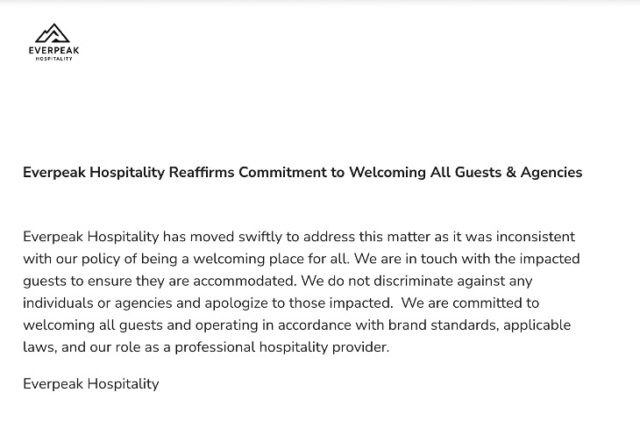
The only item on the Everpeak Hospitality website as of April 30, 2026.
This corporate focus on and responsiveness to profit maximization and shareholders does not show the full picture of this story. While Hilton’s fluctuating stock price may reflect how the company’s shareholders felt about and reacted to the situation, it is not indicative of the public’s reaction as a whole.
Online responses to the hotel’s actions varied widely, with passionate posts on both sides. Even in the replies to DHS’s initial post on X, responses differed: on one side, people spoke out strongly in favor of the government, saying they would never stay at Hilton hotels again, that ICE should raid Hilton hotels because they “100% hire illegal immigrants,” and even posting the full names and addresses of Everpeak’s owners. On the other side, some posts thanked Hilton and criticized ICE, noted that they thought Republicans “were all about letting businesses serve who they want? [R]efusing to bake a wedding cake is cool but refusing to rent a room isn’t?”, and said they would offer Hilton exclusive patronage moving forward.
Still, a corporate legal regime solely obsessed with profit maximization necessarily pushes down the perspectives, values, and interests of all non-shareholder stakeholders, not just potential customers. The competing narratives at play in a situation this politically polarizing become reduced to a percentage change on the New York Stock Exchange. Given that reality, it is all the more important to uplift the voices of the other actors in the story – namely, the hotel employees – when they are ready to speak out.
And though it reigns dominant, it is important to remember that cynical profit maximization is not the only option. This Hilton situation lies in stark contrast to another, relatively recent Minneapolis hotel situation with a much different tenor. In 2020, when Minneapolis was again at the center of national political upheaval in the wake of George Floyd’s murder, the Sheraton Minneapolis Midtown Hotel evacuated its occupants for safety reasons due to nearby protests. Local organizers convinced Jay Patel, the owner of the Minneapolis Sheraton, to let unhoused Minnesotans stay in the hotel. Patel allowed over three hundred unhoused individuals to stay, and reportedly told volunteers he was doing this to help the community. Organizers involved with this effort were also “in conversation” with the local union representing the Sheraton’s workers.
Still, a corporate legal regime solely obsessed with profit maximization necessarily pushes down the perspectives, values, and interests of all non-shareholder stakeholders, not just potential customers. The competing narratives at play in a situation this politically polarizing become reduced to a percentage change on the New York Stock Exchange.
Patel eventually called the police to evict the hotel’s residents, likely in response to multiple overdoses, sex work, and a fire on the property, and upon the police’s refusal to carry out these evictions, the activists at the site announced the hotel was closing. Eventually, the city hired a contractor to “board up the hotel, deeming it a hazard.” Through all of this, Marriot International – the owner of the Sheraton hotel brand – did not appear to make a statement on the use of the Sheraton hotel for these purposes.
Though the “hotel as a homeless shelter” experiment was short-lived and the hotel owner ultimately pulled the plug, his approval in the first place demonstrates the good that can be done when business owners choose to embody their values through their actions. As of 2025, Patel is converting the vacant Sheraton into an addiction recovery center.
![[F]law School Episode 14: Banking on Discrimination](https://theflaw.org/wp-content/uploads/2025/04/Babaian_FB3-640x427.jpg)