Stuck In The Zone
The Role of Zoning Reform in America’s Housing Crisis
Chris Lester
April 7, 2026
On February 10th, 2025, the city council of Cambridge, Massachusetts voted to adopt zoning petitions which allowed multifamily housing citywide. Prior to the decision, Cambridge had a number of restriction zones that limited the housing that could be built to single-family or two-family developments. At the same time, the city has been suffering from a housing crisis, with almost 50% of its renters struggling to pay their rent, due at least in part to a persistent lack of housing supply. The proposal and passage of these petitions was in direct response to this crisis and the desperate need to construct more housing. After the vote, staff for the city now estimate that the new zoning could result in ten times as many new homes created by 2040. This vote and the process by which it came about illustrates a growing trend of state and local governments looking to zoning reform to address our housing shortage.
The failures of our housing system have become impossible to ignore. In the latest tally taken in January 2024 by the U.S. Department of Housing and Urban Development, it was found that more than 770,000 people were counted as homeless. This was an 18.1% increase over the previous year’s tally and the highest recorded since the survey records began.
To make matters worse, while the number of people suffering from homelessness has increased, they have also been faced with increasingly hostile and punitive laws and policies. The recent decision in City of Grants Pass v. Johnson, holding that local ordinances which impose civil and criminal penalties for camping on public land do not constitute cruel and unusual punishment when applied to homeless people, has opened the floodgates for the dismantling of homeless encampments and heightened criminalization throughout the country. The availability of support services for these individuals is also due to shrink as the Trump Administration plans staff cuts up to 84% in the HUD office that administers homelessness assistance and grants intended to help communities build affordable housing and recover from disasters. At a time when more people than ever before are experiencing homelessness and the federal government and legal system seem unsympathetic and unwilling to help, solutions to this crisis are essential.
One of the largest contributing factors to modern homelessness is the availability of affordable housing. The U.S. currently has a shortage of 7.1 million rental homes affordable and available to renters with extremely low incomes (incomes at or below either the federal poverty guideline or 30% of their area median income, whichever is greater). Even if we adequately funded and staffed programs to help those experiencing homelessness find housing, there simply would not be enough supply to meet the current demand. We are in desperate need of more housing and people will continue to suffer until this need is met.
To address this shortage, substantial changes and ambitious initiatives are needed. We won’t be able to meet this moment with the same policies and practices that brought us into it. One area that has been looked to as a potential solution is the reform of our zoning system and the limiting or abolishment of the restrictions on housing construction and development that it imposes.
Exclusionary zoning is a staple of American planning and can be seen in almost every city and community. Approximately 75% of land in the U.S. is constrained by zoning practices that exclusively permit single-family residences. Virtually all cities have minimum lot size requirements (rules which specify how large a plot of land must be before housing can be built) as well as minimum parking requirements (rules which mandate that new developments provide a set number of off-street parking spots). These ordinances have been in place for decades and have in many respects become an accepted part of American life. However, in recent years, debates have broken out over the utility and practicality of these laws and practices and the barriers they impose to the development of new housing.
These debates over land use reforms are occurring in municipalities all over the country and demonstrate a complex intersection of public, private, and governmental interests. At a time when solutions to the homelessness and affordable housing crises are desperately needed, an exploration of the zoning reform movement, its various stakeholders within the housing legislation ecosystem, and the specific changes it advocates for can shed light on the obstacles to implementation of meaningful reforms and the steps necessary to chart a path forward.
History of Zoning
While zoning may seem like a fundamental part of American city planning, it was rarely used before the 20th century. Up until about World War I, virtually all of America was unzoned. In this pre-zoning era, cities and towns mainly regulated what could be built through nuisance laws, with private individuals filing suits if a nearby property or its use impaired their rights in some way. As cities grew in the wake of the Industrial Revolution, the need for more comprehensive regulations on the use and types of property that could be built led to the passage of zoning laws. However, the structures that these zoning plans took reflected a more deliberate degree of control than the previous nuisance-based approach. According to M. Nolan Gray, senior director of legislation and research at California YIMBY and author of Arbitrary Lines: How Zoning Broke the American City and How to Fix It, “the form that our cities took in the 20th century was not this emergent, spontaneous free market thing. It was heavily, heavily engineered for good and ill.”
Among the first zoning codes passed in the U.S. was the 1916 New York City Building Zone Plan. This plan arose in part due to the efforts of established commercial landlords who feared the rapid increase in the density of new office and residential buildings and its effects on real estate prices. These landlords pushed for height and density restrictions largely to maintain their market position. The plan also separated areas based on their intended purpose, designating districts for residential, commercial, and industrial use. This was partially in response to concerns about the encroachment of industrial properties on commercial shopping districts. Though amended in the years after its passage to respond to new developments and concerns, the plan in its original form became the model for cities nationwide.
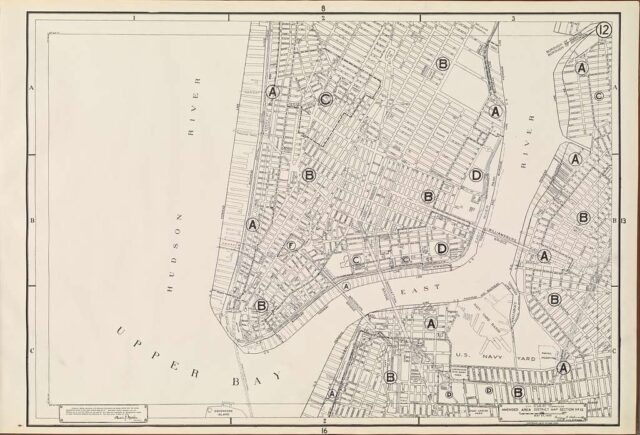
Scan of 1953 Area Zoning Map Section No. 12 by the New York Public Library – Source: https://nypl.getarchive.net/media/area-zoning-map-section-no-12-095fe8
The motivations behind these new zoning laws were varied but tended to reflect larger social and cultural attitudes. Though frequently presented as a means to sanction regulations on property in order to serve the public interest, zoning was often used to facilitate social and economic segregation. With the major population shifts occurring in the country around the turn of the 20th century, early zoning laws were designed to prevent the influx of immigrants and minorities into established communities. Some went so far as to directly prohibit the ability of minority homebuyers or renters to live on certain blocks or within certain areas. Though these types of explicit racial zoning plans were held to violate the Due Process clause of the 14th Amendment in Buchanan v. Warley in 1917, efforts to fashion legally acceptable racial zoning schemes persisted for decades.
By the end of the 1920s, zoning had become the norm for urban planning in the U.S., aided by the development and promotion of the federal government’s Standard State Zoning Enabling Act (SZEA). Created by then-Secretary of Commerce Herbert Hoover, the SZEA established a relatively uniform zoning process for cities by setting forth model legislation that, upon passage by state governments, gave localities the power to enact zoning laws. In addition to making it easier for states and cities to incorporate zoning into their laws, this federal initiative seemed to respond to those scrutinizing the constitutionality of zoning by prescribing a basic, federally-endorsed form of zoning that was likely to survive court challenges. Any further legal doubts about these land use regulations were put to rest in 1926 with the decision in Village of Euclid v. Ambler Realty Company. In that case, the Supreme Court held that the zoning ordinance at issue was a valid exercise of the local government’s police power and that such regulations would generally be upheld if they had some connection to the public welfare. With the blessing of the Supreme Court and the availability of a federally created model, zoning had found its way to the center of American city planning.
While there have been other trends and developments in the history of American zoning in the decades that followed, such as the Fair Housing Act and its targeting of zoning policies with discriminatory effects, these origins are significant to understanding how we arrived at our current zoning system and the elements that must be considered when attempting to reform it.
Voices in the Zoning Debate
Like any complex issue, there are a variety of stakeholders involved in the debate over zoning reforms, each with their own interests and motivations. While the most visible are the advocates who are seeking these reforms and the governmental bodies who are ultimately deciding whether their proposals should be passed, there are a number of peripheral stakeholders who can influence or obstruct these efforts and their implementation. Among the most important are: current homeowners who fear the changes that would accompany zoning reform, corporate landlords whose role in the rental housing market has grown in recent years, and the federal government whose policies and grant opportunities can heavily influence the actions of state and local governments. To fully understand their positions and the impact they have on reform efforts, it is worth examining each in turn.
Current Homeowners
Some of the fiercest resistance to the elimination of exclusionary zoning laws has come from single-family homeowners in the towns and cities where these reforms are proposed. They often express fears that allowing the development of multifamily housing or implementing other land use reforms will result in “spikes in traffic, strains to infrastructure, displacement of low-income residents, hits on property values and changes to neighborhood character.” Some homeowners are so motivated by these concerns that even when zoning reforms do pass, they bring court challenges to prevent them from being realized.
A recent example of this can be seen in Montana. In 2023, state lawmakers passed a series of bipartisan bills aimed at changing their zoning, land use and building codes to make it easier for property owners to build new housing. These bills proposed requiring Montana cities to permit backyard flats and other accessory dwelling units and to allow duplex homes to be built in places zoned for single family housing, as well as several other housing related measures. After being signed by the Governor, the laws were meant to take effect in January of 2024. However, in December 2023, a group of single-family homeowners from across the state challenged them. This group, known as Montanans Against Irresponsible Densification, or MAID, filed a lawsuit alleging in part that the bill package took away local governments’ ability to zone and thus “attempt[ed] to arrogate to the State powers constitutionally reserved for local governments” and “drastically reduce[d] the ability of the public to participate in governmental decision making.”
In the suit, MAID members claimed that “[a]reas zoned for single-family uses have a long and venerable history in the United States and in Montana cities. Homeowners in Montana have traditionally relied on single-family zoning designations to protect the scale, character, and financial viability of their most important investment.” The fears and underlying societal values that motivated this strong opposition are on full display here. To groups like MAID, single-family homeownership is the norm and should not be forced to give way to multifamily developments, even if it would result in more affordable housing and improved quality of life for the most vulnerable in their communities. Beyond the historical and cultural significance they attribute to single-family homeownership, they also worry about the loss on investment that allowing more housing would represent. If the supply of the housing stock increases, home prices would likely decrease and the value of their “most important investment” may suffer. As a result, resident groups like MAID and the homeowners they represent can view zoning reform initiatives as an attack on their assets that they must oppose to preserve their wealth.

![[F]law School Episode 13: The Migrant Trap](https://theflaw.org/wp-content/uploads/2025/03/Drury_FB2-e1742192209662-640x427.png)