Amazon Told Me to Read This
How Corporations Control the Book Industry
Kirsten "Shaw" Mettler
July 29, 2026
Melville House is an independent publishing house that started at the “kitchen table” of a “third-floor walk up in Hoboken.” The house was initially launched to publish a poetry anthology about 9/11 after founders Dennis Johnson and Valerie Merians noticed the proliferation of poetry in response to the attacks. As Johnson writes, “When we went into Manhattan to see the site where the Twin Towers had once stood, there were poems traced into the ash.”
Starting from its humble beginnings, Melville House is now a publishing phenom, having published “two Nobel Prize winners,” “numerous New York Times bestsellers,” and important nonfiction books. But one day back in 2004, if you pulled up a Melville House book on Amazon, you couldn’t purchase it. Amazon had removed the “buy” buttons from all Melville House publications after the publishing house had declined to pay certain promotional fees that Amazon demanded. Fees that were described to Johnson by his distributor explicitly as a “kickback.”
Though Melville House initially resisted, eventually they “had to give in and pay the bribe,” says Johnson, to get their books back on the site. They simply could not afford the loss in sales. But Johnson does not mince words when describing the experience, comparing Amazon’s practices to the “Mafia” and “extortion.”
Melville House’s conflict with Amazon was a canary in the coal mine. As advocacy groups have explained, “The open access to the free flow of ideas is essential to a well-functioning democracy.” But our access to books is not open; it is increasingly controlled by mega-corporations that have outsized influence over what we read.

Dennis Johnson and Valerie Merians originally founded Melville House to publish a poetry book. Photo provided courtesy of Dennis Johnson.
Amazon’s Dominance
Amazon is the most infamous villain in the story of books. The company controls more than 50% of the print book market and 80% of the e-book market. 71% of adult U.S. survey respondents say that they have bought a book from Amazon within the last year.
The e-commerce giant started as a bookstore. As Brad Stone explains in The Everything Store, Bezos began his career on Wall Street. He was astounded by the explosion of the internet and wanted to find a way to profit. Working backward from that premise, Bezos considered 20 different product categories to launch Amazon with. He chose books because they seemed like the best strategic stepping stone to his long term goal of an everything store.
Today, many consider Amazon to be a monopsony. It has so much domination as a middleman between book buyers and publishers that it is empowered to set prices and otherwise control book production.
As it grew, Amazon quickly became a predator, with small publishing as its initial prey. An internal Amazon initiative, named Project Gazelle, aimed to squeeze small publishers like Melville House by demanding better terms in exchange for the continued ability to sell on Amazon. The effort got its name after Bezos allegedly said that “Amazon should approach . . . small publishers the way a cheetah would pursue a sickly gazelle.” Amazon focused its efforts on the publishers most dependent on them for sales.

Books in the Lost Art Press warehouse. Photo provided courtesy of Christopher Schwarz.
Some independent publishers like Lost Art Press have managed to avoid Amazon all together, but co-founder Christopher Schwarz will be the first to tell you “it’s a million times harder.” Lost Art sells direct to consumers and handles their own fulfillment. In the earlier days, before Lost Art got a warehouse, walls of books blocked Schwarz’s guest bedroom and stacks of books sat under his kid’s beds. Friends and family all worked together to ship out orders.
But for most independent publishers, when Amazon demands extra fees or better prices, there is little they can do. Too many book sales go through Amazon to give up that market. Now, Amazon gets an effective discount of about 60% on books from small publishers. According to Chokepoint Capitalism by Rebecca Biblin and Cory Doctorow, “Amazon’s bully tactics brought the gazelles meekly in line.”
Amazon’s control extends past prices. They might even choose the color of your next book cover. According to Johnson, Amazon slapped Melville House with extra fees for making a book with a white cover, claiming that white needed special packaging and handling because it was easier to smudge. There’s no negotiating with Amazon, so now Melville House avoids white covers.
As Allison Hill, Chief Executive Officer of the American Booksellers Association wrote over email, “Amazon owns the playing field.”
The “Altruistic” Big Five
Amazon cut off consumers from access to books as a negotiation tactic.
While Amazon is often castigated as the villain, publishers are typically idealized. Writer Elle Griffin says publishing houses are often described as “altruistic” or “virtuous” because they historically pursued the “good and valuable and righteous and virtuous” work of finding good work to publish. A narrative that major publishers need to be protected from Amazon has proliferated.
It’s true that Amazon has tried to gain control over publishers large and small. In 2014, contract negotiations stalled between Amazon and Hachette, one of the world’s largest publishers, over the discounting of e-books. Amazon responded by removing the pre-order options for some Hachette books, delaying deliveries of their titles, and even omitting some Hachette books from search results. Amazon cut off consumers from access to books as a negotiation tactic. According to Biblin and Doctorow, Hachette had “no alternatives” and “was forced to give in.”
But “[d]on’t feel too sorry for the largest publishers,” write Biblin and Doctorow. The five largest publishing companies, commonly called the “Big Five,” control 80% of the trade book market. As large corporations, the Big Five publishers have more negotiating power with Amazon, plus advantages of economies of scale that allow them to profitably publish despite Amazon’s increasingly demanding terms.
Unlike the big publishing houses, who have some negotiating power with Amazon, independent publishers essentially have none. As Schwarz explains, when independent publishers sell on Amazon, Amazon is “in charge of your business in a lot of ways.” “There’s no give and take,” Schwarz says. “There’s not even really a person to talk to for the most part.” “Amazon’s tactics . . . actively tilt the competitive playing field in favor of the biggest firms,” write Biblin and Doctorow.
Plus, the Big Five publishing houses have engaged in their fair share of anticompetitive behavior. In 2015, the Second Circuit ruled that Apple violated antitrust laws by coordinating with the major publishers to price fix e-books.
Apple and book industry insiders argued that, in this case, the price fixing was beneficial for consumers, as it helped wrestle power away from Amazon, so it should be allowed. Judge Livingston condemned the theory as “a concept of marketplace vigilantism that is wholly foreign to the antitrust laws.”
Fast forward to 2022, and the District Court for the District of Columbia halted a proposed merger between Penguin Random House and Simon & Schuster. At the time, the two companies combined accounted for approximately 28% of all books sold, and the DOJ estimated they sold about half of the country’s bestsellers. As Barry Lynn of Open Markets Institute, an antitrust advocacy organization, explains, the publishers attempted to frame their own mega-merger as a necessary step to protect the industry from Amazon.
But such arguments are “obviously very problematic,” says Vanderbilt Law Professor Rebecca Haw Allensworth, because it would give corporations an almost endless justification to claim that “whatever makes us stronger, including on the backs of consumers, on the backs of workers, is good for competition.” While Lynn acknowledges that Amazon may pose a legitimate threat to major publishers, the more appropriate response would be regulating Amazon, not letting already massive publishers concentrate even more power.
And it’s far from clear that allowing the major publishing houses to get bigger would protect the book industry from Amazon. Although Penguin Random House has extensive market share, Alex Shephard writes that there is little evidence the company has used that power to go toe to toe with Amazon. Instead, it has acted with “timidity.”
Major publishers were happy with Amazon until they realized how much power they had given away.
The Big Five are not simply innocent victims, forced to consolidate in the shadow of Amazon’s power. While increased pressure from Amazon may be pushing the major publishers to consolidate, corporate consolidation has long been pervasive in book publishing. In the 1960s and 70s, international media conglomerates began gobbling up publishing. As Judge Pan documented in her opinion on the Penguin Random House merger, consolidation has continued at a steady pace. “The Big Five have achieved their market dominance in part by acquiring other publishers,” she wrote.
Today, four of the Big Five publishers—Hachette, HarperCollins, Macmillan, and Penguin Random House—are owned by international media conglomerates. Private equity owns the remaining one, Simon & Schuster.
Major publishers were happy with Amazon until they realized how much power they had given away. As writer Charlie Stross explains, “[P]ublishers handed Amazon a monopoly on the customers—and thereby empowered a predatory monopsony.”
Andy Hunter, the founder of Bookshop.org, an online marketplace for independent bookstores, says the publishers were like Hansel and Gretel. Major publishers decided to rely more and more on Amazon for their revenue, letting independent bookstores “fend for themselves.” As Amazon’s market share grew, it stuck publishers with worse and worse terms.
Hunter says that publishers kept thinking, “We can’t upset the witch because the witch is who’s giving us all the candy. But in the end, the witch is going to eat them.”
Books Are Not Widgets
Stone writes that Bezos chose to sell books on Amazon, in part, because they were “pure commodities.” Mark Dohle, the Chief Executive Officer of Penguin Random House, has compared the book industry to venture capital. But these analogies miss how books are unique.
As Umair Kazi, Director of Advocacy for the Authors Guild remarks, books are “not like widgets,” and they are “not like other commodities.” Judge Pan similarly wrote that the book industry is a “commercial market,” but also “inextricably intertwined with the intellectual life of our nation.”
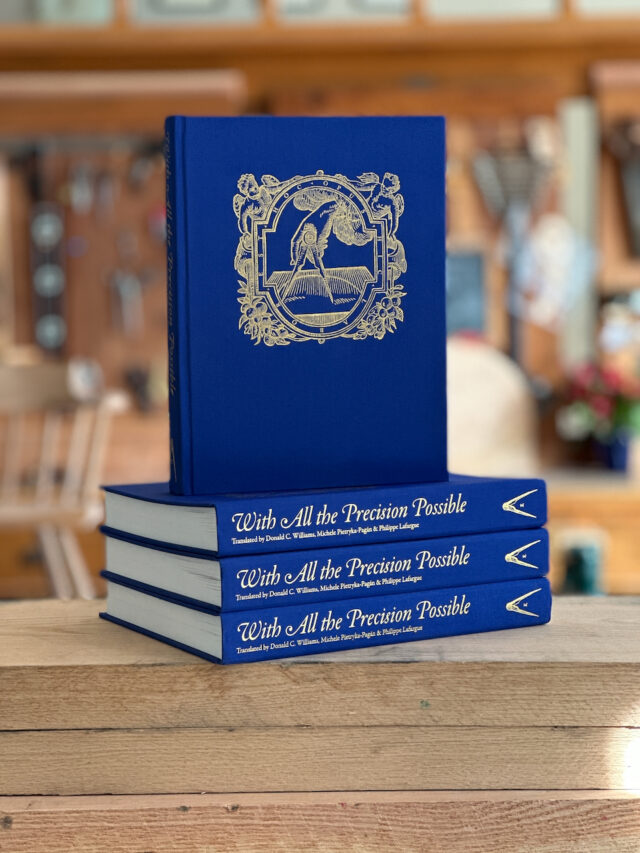
A book published by Lost Art Press. Photo provided courtesy of Christopher Schwarz.
Law professor Maurice Stucke of the University of Tennessee has studied a similarly intellectually important market: news media. When Clear Channel, a major media corporation now known as iHeartRadio, bought up local radio stations, observers like Stucke were concerned about what this would do to the news ecosystem.
Stucke explained that what followed was a “homogenization of content” and “a reduction in local news” that tangibly harmed consumers. Some looking at the book industry believe that the domination of mega-corporations is similarly degrading the quality and diversity of books.
Devaluing Authors
A 2018 survey from the Author’s Guild found that median author income declined 42% from 2009 to 2017
One way corporate power impacts the vitality of the book market is by forcing low prices, which hurts authors. As Professor Peter Carstensen explains, companies trying to comply with demands from a monopsony like Amazon for low prices often find the money by cutting wages. This story appears to align with the realities of author pay.
A 2018 survey from the Author’s Guild found that median author income declined 42% from 2009 to 2017, with many respondents pointing to Amazon as a reason behind the decline. According to Biblin and Doctorow, author advances—a form of prepayment from publishers to authors before a book is released—have decreased by half since 2007. Authors are “the lifeblood of the industry;” it seems obvious that cutting author pay will influence what books get published and what people can afford to be authors.
Some worry that pricing pressure will shrink the already limited diversity in publishing. A study of some of the most widely read books published between 1950 and 2018 found that 95% were written by white people. Similarly, only 20 of 220 books on the New York Times Bestseller list in 2020 were written by people of color. In 2020, authors shared social media posts to expose massive disparities between the advances paid to white and Black authors.
Because authors are generally hired for books contract by contract, rather than as standard employees, authors are limited in their ability to organize against the shrink of their pay. Antitrust law has an exception that protects most labor organizing for employees, but that extension does not apply to authors, who the law sees as independent contractors. “Chicago school antitrust theory doesn’t just allow firms to get very big; it simultaneously clobbers independent workers who seek to band together to collectively enforce their rights,” write Biblin and Doctorow.
“As the big houses have become bigger and bigger, their business has become more about making money than art or protest.”
Biblin and Doctorow call the shifts in author pay a “heist.” But some like Schwarz are attempting to resist these trends. When he was at a large publisher, the company spent money on “bloat,” like fancy offices and airplanes. Lost Art keeps their operations as lean as possible so that they can fairly compensate authors. Corporate entities, on the other hand, are squeezing authors.
Protecting the Bottom Line
Kazi explains that there is also a concern that as publishing consolidates, there could be a “flattening” of what gets published because houses will become more “beholden to the bottom line.” “Consolidation has an impact on the types of books, the types of voices” that get published, says Kazi.
According to Johnson, “As the big houses have become bigger and bigger, their business has become more about making money than art or protest.” Small publishers release “a far wider variety” of books, focused on “art making and truth-to-power-speaking, of actual risk taking-and from a far more diverse group of authors,” as compared to “commercial conglomerate publishers.” Johnson calls the major publishers “robotic” and “homogenized.”
The Authors Guild, an advocacy organization for authors, argues that “publishing consolidation” has already led to both “a reduction in diversity among authors and ideas[ and] a more conservative approach to risk-taking.”
Amazon’s practices also incentivize a safe, homogenous book market. By pushing prices down, Amazon discourages all publishers from exploring more original, risky projects. Amazon “will reduce the room for new authors to publish, since existing publishers will want to keep their most successful prospects and the new, riskier prospects will be the first to hit the chopping block, so to speak,” writes economist Connor Lennon. “This will reduce the diversity of books being published, which for many readers is a very bad thing.”
A salient example of book homogenization is the rise of celebrity memoirs. 290 celebrity memoirs were published in 2025 alone. Reading through the transcripts from the Penguin Random House merger trial, Griffin noticed a pattern. The big publishers liked celebrity memoirs because they were cheap, safe bets. Celebrities have built in audiences, meaning predictable profits and less spent on advertising.
Big publishers could afford to take on more interesting projects, argues Johnson, but “everything about a big company like that is about risk aversion.” Large corporations are incentivized to go after large audiences and guaranteed sales.
“They have the money. They could fight Trump if they wanted to. They could do edgier fiction if they wanted to. They could do more diverse publication if they wanted to,” says Johnson. “But they don’t want to take the chance.”
Larger publishing houses do not have the same “editorial freedom,” according to Schwarz, that he has at his independent press. As an example, Schwarz recounts that one year while he was working at the larger publisher, the company had a “homerun” with a hobbyist book called The Art of Painting Animals on Rocks. It was the company’s “biggest seller for years” and so, according to Schwarz, “the company went bananas saying, ‘we need to come up with other things that people can paint on other things,’” encouraging copycat pitches like “painting animals on gourds.”
Chasing consistent financial success meant the publisher would “repeat themselves or repeat what other people are having success with” because they were “trying to chase trends,” says Schwarz.

Inside a Lost Art Press book. Photo provided courtesy of Christopher Schwarz.
But Lost Art, on the other hand, is able to invest in long-term, meaningful projects, not just what is the fad at the time. As an example, Schwarz explains that Lost Art took on a major project to translate a French woodworking book from the 18th century. The project was a massive undertaking, involving two experts from the Smithsonian and a French woodworker.
Or, in another project, Lost Art published a book that revitalized an old recipe for making edible, non-toxic paint from milk. According to Schwarz, these are not the kind of projects that commercial publishing takes up. As an independent publisher, Lost Art is able to take risks that bigger entities just don’t.
When you’re a writer, you envision your audience. They’re in your head. You’re writing to somebody
Perhaps even more importantly, Lost Art pursues these more unusual projects because it is customer focused. As a craftsman himself, Schwarz and his team don’t just think about what will sell; they think about what is useful knowledge to share.
Reflecting on the woodworking translation project, Schwarz says, “Why wouldn’t you want the advanced knowledge out there?” Lost Art pursues important, difficult material because, unlike larger publishers, it asks, “What is important, what does the craft need, what does the community need?” As opposed to, “what will they buy?
Johnson feels similarly. As a writer himself, he thinks about business realities, but he also thinks about books from an artist’s perspective.
“When you’re a writer, you envision your audience. They’re in your head. You’re writing to somebody,” says Johnson. “I feel like I publish that way.”
The Political Cost
Risk aversion could decrease book quality and variety, but it also has direct implications on our democracy. Melville House spent December 2014 working around the clock in a Brooklyn warehouse with inconsistent heat. The Senate had just released a critical report on CIA torture as a clunky PDF, and Melville House decided to “crash” publish it, meaning they made a book version of the torture report in just a matter of weeks.
Employees and volunteers converted hundreds of pages of government documents into a usable manuscript. They used rulers to measure redactions by hand, since there is no standard typeset for a redaction. Supporters sent food and beer to the warehouse to keep the team going.
But all those hours shivering after the bodegas had closed were worth it. By December 30th, the report was published, with Melville House releasing both a searchable e-book version and physical copies.
Human rights groups thanked Melville House for their efforts; The book versions made combing through the report more accessible. “We thought we did the world good,” said Johnson.