Weaponizing Our Work Ethic
Corporations Work Hard to Make You Work Harder
Martin Konstantinov
April 21, 2026
“If hard work were really such a great thing, the rich would have kept it all to themselves.”
– Union Activist (from The Problem with Work: Feminism, Marxism, Antiwork Politics and Postwork Imaginaries)
A Hop, Whistle, and Fart
We the people have forever tried not to work too hard. From medieval flatulists who found their calling as particularly noxious court jesters to comedy film protagonists who stop at nothing to avoid the tedium of their desk jobs, we have long searched for ways to do what we love without running ourselves into the ground.
This Sisyphean task has almost always been for naught. As one would expect, there were not enough jobs as flatulists to go around. Medieval peasant life was brutal, a daily struggle to get enough food to eat while performing backbreaking labor for this or that lord. The plight of the impoverished extended through the Industrial Revolution, where suffering in the fields was replaced by toil in the factories.
Despite technological advances and the development of a massive global services sector, workers today experience alarming rates of disengagement and unhappiness. Half of all American workers experience high levels of stress at their jobs; common sources are hours worked, an increase in unmanageable workloads, and unreasonable time pressure. There is a correlation between serious psychological distress and working while unwell, working variable shifts, an increase in hours, and an inability to take time off. Such psychological distress is correlated to heightened risk and occurrences of heart disease and stroke, substance addiction, and suicide, with the strongest impact on blue-collar workers.
Faced with the same bleak prospect of never-ending, harmful work, the medieval peasant and early industrial classes dreamed of escape. Captured in song and art, myths like the land of Cockaigne offered an imaginary alternative, where every worker’s comforts were satisfied and idleness was the norm. Here, workers had the power to determine what to do with their time. Those who usually lorded over them either did not exist or were themselves relegated to subservience.
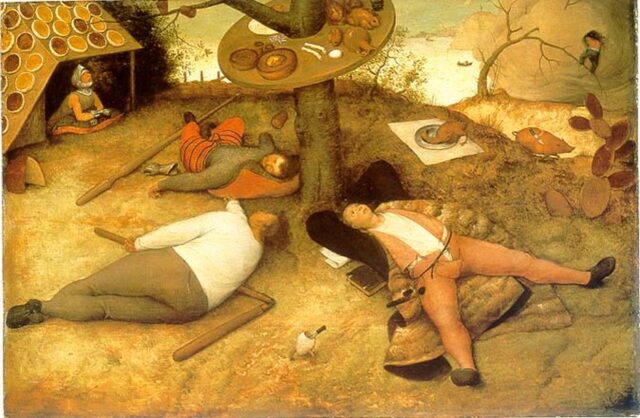
Painting provided by Flickr under a creative commons license.
Cockaigne is not a real place. In the twenty-first century, the harshness of peasant and industrial serfdom has developed through an economic, legal, and cultural logic that forces people to overwork themselves. Corporations have implemented a system of perverse incentives to reward (or not punish) those who work too hard. It is an all-too-cruel irony that corporations labor at great effort and expense to erode worker protections through lobbying and political leverage. Such efforts extend past courthouses and capitols to the cultural mainstream. That one must exhaust themselves for the greater good is a rhetorical certainty in advertising and media. Hard work is valorized; “laziness” is translated into shame and stupidity. Through this unholy trinity of the workplace, law, and culture, corporate power systematically destroys our conception of fulfilment and balance with work and across our lives.
The Corporate Cerberus

Image from PICRYL under a creative commons license.
The Workplace
The modern workplace is chock-full of performance targets, an all-consuming game of financial carrots and sticks. Lawyers and consultants are not the only ones whose entire professional lives are centered on the billable hour or other metrics that equate performance with time spent on the job. Salaries and market bonuses are often directly tied to the sheer number of hours that one works. The corresponding stick: the threat of less compensation or being fired for “not working hard enough.”
Beyond reward and punishment, employers in both warehouses and offices use pernicious tracking mechanisms such as mandated wearable devices, clock apps, biometric scanners and motion sensors, and nudging programs to maintain a watchful eye on employees and ensure that they are working as hard and for as long as they can, in the office, out on the job, and at home. Tracking software is often used to evaluate and rank employees, guaranteeing that quantity of work is prioritized over all else.
Moreover, corporations are quick to collaborate and actively publish information on best practices to keep track of employees, facilitating a race to the bottom in which companies of all shapes and sizes work as hard as possible to make sure that their employees are doing the same.
Thus, the incentives of the workplace create a structure of performance and competition directly tied to the quantity of work completed. The more one does, the more money the company makes, and, as long as that work is done in a reasonably efficient manner, the employer is happy. When the potential cost of disobedience is the loss of employment, workers feel no choice but to accept constant monitoring as a condition of their work. In workplaces modeled on job precarity, any semblance of a balanced and healthy life is destroyed.
Through this unholy trinity of the workplace, law, and culture, corporate power systematically destroys our conception of fulfilment and balance with work and across our lives.
Corporate leaders will proudly declare that hard work is all for the best. In its constant quest to maximize profits, the history of American capitalism has been intertwined with a spirit of assiduous labor, echoed from the titans of industry and invention. As Henry Ford purportedly oft repeated, “the harder you work, the luckier you seem to get.” Thomas Edison championed genius as “1% inspiration and 99% perspiration.” Today, Elon Musk has said that you just “have to put in 80 to 100 hour weeks every week” to improve “the odds of success.” And Kim Kardashian commands women: “get your f****** ass up and work.”
Coming from the perches of the boardroom and billionaire penthouse suites, the corporate answer to the dilemma of “overwork” is simple: there is no such thing. Rather, “overwork” really just means working hard, and working hard is necessary to climb atop the corporate hierarchy – the only goal worth living for.
The Law
Corporate actions speak as loud as their words. To match their zeal for tracking and rewarding time spent on the job, corporations constantly lobby for the erosion of basic worker protections, such as limits on the amount of time one works. That conglomerates fund pro-business interests in Washington is no secret. Equally unsurprising but somewhat less discussed are their efforts focused on directly influencing the Supreme Court to render decisions favorable to corporate interests.
Through cases such as Lochner v. New York, early twentieth century laws limiting the amount of hours employees could work in particular industries were invalidated on the grounds of workers’ freedom of contract. However, as part of Franklin D. Roosevelt’s New Deal, the Fair Labor Standards Act of 1938 (FLSA) set a maximum 44-hour workweek, later reduced to forty hours, and required overtime pay for extra hours worked. Upheld by the Supreme Court in United States v. Darby in 1941, the law marked a major win for workers.
In recent decades, however, corporate lobbying has had considerable success influencing which cases are reviewed by the Supreme Court, as well as how those cases are resolved. Beginning with the infamous Powell Memo, organizations like the Chamber of Commerce have made a concerted effort to influence Court decisions. Since 1998, the Chamber has spent almost $2 billion on lobbying, making it by far the largest lobbying organization around. A sizable chunk of that money goes toward the U.S. Chamber Litigation Center (CLC), which focuses on amicus filings and advocacy strategy in support of the organization’s pro-business aims.

Image from Wikimedia Commons under a creative commons license.
The CLC is particularly active in district and appellate courts, fighting “for business at every level of the U.S. judicial system.” It is also a friend of the Roberts Court. In recent years, the Court has rarely considered overturning cases won by corporate interests while often reviewing and overturning worker victories. Through successful amicus filings, the Chamber has participated in and won a startling amount of cases in front of both liberal and conservative-leaning Courts, including a staggering 83 percent of the cases in which it filed briefs during the 2021 Court term.
It is no surprise that the Chamber has successfully filed more amicus briefs than any other organization over the past two decades. Of course, it may be the case that the Court is more a friend to the Chamber’s interests than the other way around, championing constitutional analyses that subvert worker protections and protect corporate interests. Regardless, both are for the most part of one mind when it comes to agenda and outcomes.
The consequences of corporate interest lobbying on Court decisions regarding work time regulation are readily apparent. Although the FLSA mandates that employers pay workers for overtime, any job that earns more than $684 per week can be exempted from this requirement. In E.M.D. Sales, Inc. v. Carrera (2025), the Court, accompanied and supported by a CLC amicus brief, issued a unanimous ruling to lower the burden of proof on employers when determining how to classify employees as exempt from overtime pay.
Through successful amicus filings, the Chamber has participated in and won a startling amount of cases in front of both liberal and conservative-leaning Courts, including a staggering 83 percent of the cases in which it filed briefs during the 2021 Court term.
This decision follows a decades-long pattern in which the Court has made it more difficult for employees to challenge overtime violations. Such cases fit in well with the overarching trend of the Court as a champion of pro-business interests and enemy of corporate regulation. Reducing the risk of corporate liability and reprisals, as well as making it more difficult for workers to organize against antagonistic corporate demands, the Court has granted corporations increasing power to make employees work longer without fear of punishment by the government or citizenry.
The Culture
It is not just in cubicles and courtrooms that corporations distort the obligations placed on employees to work for as hard and as long as possible. The remnants of Weber’s Protestant work ethic, an emphasis on the virtues of hard work, are an ever present part of American culture and collective consciousness. With pride, advertisements for energy supplements market themselves as a solution for “that 2:30 feeling.” The concept of “hustle culture,” a product of Silicon Valley’s entrepreneurial frenzy, still holds critical purchase in an age where access to work outside the office has expanded to the point that it is almost impossible to unplug from many jobs.
Company mottos from corporate giants like “Work Hard, Have Fun, Make History” (Amazon), “Work Hard, Play Hard” (Goldman Sachs), “Up or Out” (McKinsey), and “Impossible is Nothing” (Adidas) lionize the worker, who sacrifices all personal needs and desires to help their employer, as well as the entire economy, function and thrive.