What do Recruiting Companies Provide?
TJ Caswell, who serves as the director and recruiting coordinator for Maryland-based DMV Prospects Baseball (an elite summer team), argues that, though recruiting-focused tournaments are more expensive than they need to be, they do provide some genuine benefits to players who can afford to participate. “We play PBR events because we know we’re going to play good teams,” Caswell says of his DMV Prospects teams.
But strong competition comes with drawbacks. “I rarely saw coaches at Perfect Game tournaments,” he recounts. “A lot of times, in those tournaments where you have 350 teams, they’re focusing on teams they already know. They rarely go to these tournaments not having a clue and just showing up to watch games.”
Caswell believes that top-level tournaments can be effective tools for college coaches to conduct final evaluations of prospects in games that are likely to feature college-level competition–but usually only for players of whom colleges are already aware. Caswell does not view tournaments as absolutely necessary for a player to be recruited – stories like Robert Burr’s are not uncommon – but rather one tool among many of which a player might take advantage during the recruiting process.
In Caswell’s view, showcases are more beneficial in the system’s current state. The value of most showcases is not direct exposure to college coaches, who may or may not be in attendance, but rather the production of verified metrics and professional-quality video. Caswell describes scenarios in which he recommends players to college coaches, who then use PBR’s or Perfect Game’s databases to see their verified pitching velocities, spin rates, hitting exit velocities, 60-yard-dash times, and other metrics that college coaches deem important. But the PG or PBR stamp of approval comes at a cost. “You’re paying $300 for these showcases and you’re getting your metrics – you can go to any indoor facility and get the same exact metrics. But some schools just use that to verify.”
Finally, there is a small number of showcases in which the benefit is, in fact, direct exposure to college coaches. The $1000+ showcases from which both the author and Robert Burr received college offers – in the author’s case, from a school with which no previous contact had been made – have demonstrated the value of their product. But the prohibitive cost of these programs is, for many players, just that: prohibitive. Caswell’s program, in response, has made deals with showcase companies to provide discounts for his players, and has also begun holding program-specific showcases funded by DMV Prospects’ parent nonprofit. These are benefits to which the majority of players do not have access.
As demonstrated, the potential benefits of participating in expensive showcases and tournaments are as follows:
- Access to quality competition: Most local tournaments across the country do not feature consistent college-level competition.
- Final “checks” before offers are made: Situations like Robert Burr’s, in which a coach attends an event intending to watch players with whom a program has already been in contact, occur frequently.
- Verified metrics: It is nearly impossible to verify velocity readings or 60-yard-dash times based on home video or produced at an independent facility.
- Direct exposure to college coaches: As rare as it may be for college coaches to “discover” players at high-priced tournaments or showcases, it does happen on occasion.
These benefits are real. Though the marketing presented by these companies overstates the effectiveness of their products, the parents of non-blue chip baseball players who are nevertheless good enough to play some level of college baseball do not pay companies like Perfect Game, PBR, and others for no reason.
Their allegiance is to profit, market share, growth, and investors – interests which run counter to benefiting non-wealthy players who hope to play college baseball
But these benefits exist largely due to the manner in which recruiting corporations have collectively cornered the baseball recruiting market. Competition is limited at less expensive tournaments because recruiting-focused players almost exclusively play in recruiting-focused events. The use of expensive tournaments as “final checks” is a direct result of the limited competition found elsewhere. The need for corporate recruiting companies to provide “verified” metrics only exists because the option is available – if these showcases were to disappear, the value of “unverified” metrics would skyrocket. And college coaches congregate at expensive events for a litany of reasons, chief among them that the showcase companies themselves pay for coaches to attend, which few local tournaments or individual players can do.
Photo provided by Rawpixel
The Corporatization of Baseball Recruiting: An Injustice?
PBR, Perfect Game, and every other baseball-recruiting-focused corporation act exactly as one might expect them to. These companies are not public athletic institutions with a duty to preserve equalized, meritocratic access to college baseball recruiting. Rather, their allegiance is to profit, market share, growth, and investors – interests which run counter to benefiting non-wealthy players who hope to play college baseball.
Under the current system, these corporations’ managers are responsible not for providing reasonably priced recruiting services to baseball players who need them, but for maximizing the profitability of their assets (which include facilities, organizational capabilities, online services, and brand equity). If parents are willing to pay $1000 for a showcase, a for-profit entity has little reason to charge less. The pursuit of profit maximization as determined by the market, in theory, absolves these companies from accusations of injustice; they have priced their services at a level that the market indicates is correct.
And yet, there is absolutely an injustice occurring.
Consider the following hypothetical: a pitcher – call him Chris – competes at a high level for his high school team. He throws an 86-mph fastball and is, statistically, a reasonable candidate to play baseball at the collegiate level. Chris’s family can’t afford to sign him up for a summer travel team that requires players to pay thousands of dollars in tournament entry fees, nor can the family afford to send him to showcases hosted by Perfect Game, PBR, or Headfirst.
At the end of his junior year of high school, Chris sends videos of himself pitching for his high school team to a few colleges he is interested in attending; his family can’t pay full college tuition, but he is hoping to receive a baseball scholarship or financial aid. A school’s recruiting coordinator responds with a list of tournaments and showcases that the school’s coaching staff will be attending and asks if Chris will be pitching at any of them. He won’t be.
Chris operates in the difficult position of being good enough to attract some attention from college coaches but not enough of a standout to receive an offer sight unseen. There are thousands of pitchers who throw 86-mph fastballs and dominate their local high school leagues, but only some of them are good enough to play in college. This is the type of player who often needs to prove himself against top competition in a summer tournament or showcase; without the financial means to do so, Chris and players like him can be left on the outside looking in.
A player with exactly the same skills as Chris who has the financial means to attend a tournament or showcase with their desired school in attendance vastly increases his chances of being recruited to play at that school. He also has the opportunity to play in front of other schools who might happen to be in attendance. In a country where 30% of households make less than $50,000 per year, a substantial number of players face this stark disadvantage.
While Chris may be hypothetical, Aaron Ramirez is not. Aaron (whose name has been altered for the sake of privacy) is Chris – or, more accurately, Chris in eighth grade. Aaron is a talented youth baseball player on an elite travel team in the Mid-Atlantic region. He isn’t physically imposing – no Division I coach is going to recruit him based on athleticism alone – but he is skilled, plays multiple positions, and does the “little things” coaches love. He is exactly the type of player who might, in a few years, enter the recruiting process in hopes of playing some level of college baseball. But, like Chris, Aaron’s family simply cannot pay what is necessary to engage fully in the recruiting process; they’re already struggling with team fees for his 14U travel team.
Aaron’s mother, Maria (whose name has also been altered), explains the situation. “You see the potential on the kid, and then that’s when you decide they need a better team, better competition. But everything is really expensive – it’s a business, not a love of the sport…Now I see some organizations doing showcases where they charge you $300, $500…That’s something where I’m like, no, I can’t do that.”
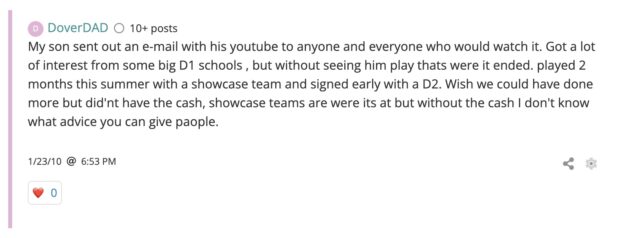
Online baseball forums are filled with testimonials from parents of talented players facing this problem. One example from HSBaseballWeb.com:
Screenshot taken by George Roggie
The corporations discussed in this article are neither cost-conscious youth baseball organizations nor luxury recruiting services; they are both expensive and essential. Recruiting corporations have cornered the market; though it is not necessary for players to engage with (and pay) any individual company, it is essentially required of many players that they engage with one of them. There is no evidence that the corporations discussed in this article take the financial health of their clients into account when setting prices and making decisions; profits are the goal. This is what has broken the college baseball recruiting process for players who cannot afford to buy access to exposure, verified metrics, and elite competition.
How Can This Be Solved?
The exclusive nature of the college baseball recruiting system cannot be solved by simply hoping that recruiting corporations will lower their prices. Their business model works; there is no shortage of players with families willing to shell out thousands of dollars for their services.
the primary benefit of attending showcases – metric verification – can be achieved practically anywhere.
Instead, an alternative must be created. There must be a way for players to achieve all the benefits currently available only through expensive recruiting corporations without paying thousands of dollars for the privilege. As such, any proposed solution must do the following:
- Provide opportunities for players to compete against quality competition
- Provide verified, standardized metrics that are available to all
- Provide college coaches with opportunities to see players who they have already identified as potential prospects play in-person
- Provide direct exposure to college coaches such that players can be “discovered”
Problem #1 will be solved by any new system that achieves points #2-#4; if the recruiting benefit is there, top talent will come (as demonstrated by the recruiting companies that currently exist).
The easiest of these problems to solve is #2. USA Baseball, the nonprofit national governing body for amateur baseball in the United States, should certify facilities around the country as trusted metric-measurement sites. As TJ Caswell says, the primary benefit of attending showcases – metric verification – can be achieved practically anywhere. USA Baseball certification should come with the requirement that facilities not overcharge for metric evaluations; while they might not be offered for free, they certainly should not cost hundreds of dollars. Those metrics should then be displayed in a publicly available database operated by USA Baseball.
The third and fourth benefits provided by expensive showcases and tournaments are more difficult to replicate. Convincing college coaches to attend events, particularly events that are far away from campus, is not easy. Large recruiting corporations get around this by paying for coaches to attend; for the showcase that Caswell runs for his program’s players, he does the same.
A solution could come in the form of a collaboration between USA Baseball and state and local governments. USA Baseball could certify public recruiting events, provide travel stipends for coaches from lower-resource college programs, and give participating schools access to the event’s free metrics database. These regional recruiting events could be held, at little or no cost to participants, on public (government-controlled) fields during the summer. Coaches would receive room and board – no more – and players would have the opportunity to perform in front of college coaches without paying high rates to recruiting corporations.
Though USA Baseball does run regional events for US National Team recruitment, no system like the one proposed in this article exists for college baseball recruiting. Jeff Passan, writing for Sports Illustrated about arm injuries in youth baseball in 2016, presents compelling evidence as to why:
The number of youth and high-school-aged patients among Dr. James Andrews’s ulnar collateral ligament (UCL) reconstruction cases jumped from 4% in 1997 to 26% in 2003. Andrews now estimates that one-third of his patients are under 18. He doesn’t call out Perfect Game by name. Next to nobody does. It is a powerful entity, and even top major league officials decline to talk about it on the record.
The silence Passan describes is not limited to those concerned about arm injuries. Summer travel coaches rely on entry to elite tournaments to field competitive teams and play strong competition. Colleges and even MLB teams rely on these companies’ databases to track verified metrics. Parents hoping for their sons to play college baseball dare not make enemies of the recruiting corporations that claim to hold the keys to the gate between their sons and college coaches. With no viable alternative, the system is an oligopoly: speak out against recruiting corporations, and risk losing access to the real benefits they sell.
Conclusion
This article was born out of a simple observation based on my own recruiting experience. I was a good enough pitcher to play some level of college baseball. This is demonstrated by the fact that multiple colleges offered me spots on their teams. But every single offer I received was the result not only of my pitching skill, but also of my family’s willingness and ability to pay for me to attend events hosted by profit-maximizing corporations. Had my family been unable to pay for me to participate, I simply would not have had the opportunity to play college baseball.
This fact is a result of the dominance of the baseball recruiting world by the very corporations involved with my recruitment. Certainly, there are other ways to be recruited: via coach connections, school-specific camps (which also usually cost hundreds of dollars), or pure talent (these are the “blue-chip” prospects). But for many players with stories like mine, the corporations discussed in this article are the unavoidable – and unaffordable – gatekeepers of college baseball.
The diagnosis is simple: the corporate form, which emphasizes profit maximization over considerations of public good, does not lend itself to meritocracy among clients unless money and merit coalesce. Baseball recruiting is an industry in which money and merit are unrelated; good players deserve attention from colleges regardless of their families’ financial status.
The prescription is not to reform the current model. Ultimately, a recruiting landscape motivated by corporate profit will always leave some players out. Instead, a new, competing system must be created; the one proposed here, led by USA baseball, is just one example of how a nonprofit organization could strike a serious blow to the corporate dominance of baseball recruiting.


![[F]law School Episode 4: Public Interest Propaganda](https://theflaw.org/wp-content/uploads/2024/05/HERO_OBERMEYER-640x427.jpeg)