The Punctilio of Humanity
Can OpenAI save both humanity and its shareholders?
Apostolos Latsonas
August 25, 2026
I. The Puzzle (Ben and the Reversal)
Imagine your friend Ben has been a devoted vegan for the past few years. He regularly lectures everyone in your group about how meat consumption destroys the environment, is cruel to animals, and ultimately endangers humanity. No one in the group really minds, even if he can sometimes be a bit insufferable.
Then, a few months ago, Ben shows up to your usual Friday evening plans and orders a steak.
Everyone is caught off guard. He shrugs it off. Maybe, he says, it is not so bad after all to eat meat. He has reconsidered it. Saving humanity, it turns out, does not necessarily require a vegan diet. With a few other adjustments on how he organizes his life, he can achieve the same ends.
You could, of course, take Ben at his word. People change their minds. The world is complicated. Perhaps he simply learned something new.
But there is another way to see it. When someone has spent years presenting a course of action as necessary to prevent serious harm, a shift like this can feel less like a simple change of mind. It may not simply be new information, but a change in how strictly that earlier commitment is understood.
OpenAI’s recent corporate restructuring tells a version of that story.
II. No Shareholders, Only Humanity
Sam Altman runs an AI corporation that, in its early years, presented itself in unmistakably nonprofit terms—and did so loudly, in much the same way Ben once lectured the group at every Friday dinner.
In 2015, before open AI was incorporated, in an email to Elon Musk, he suggested that Google, a for-profit company, should not be the one to develop powerful AI, and that such technology would be better housed in a nonprofit structure so that it belongs to the people. [Latsonas_1]
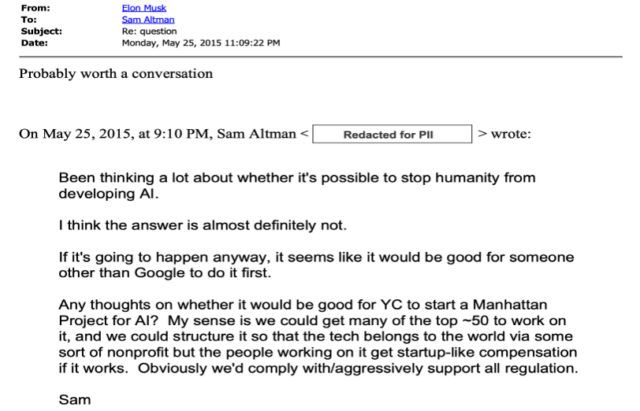
In a 2015 email correspondence, Sam Altman and Elon Musk discuss the need for a nonprofit structure for OpenAI. Found at SOURCE
It was indeed probably worth more than the conversation Musk suggested in his short reply to Altman. In December 2015, OpenAI was incorporated as a nonprofit corporation in Delaware.
The Certificate of Incorporation makes its mission clear:
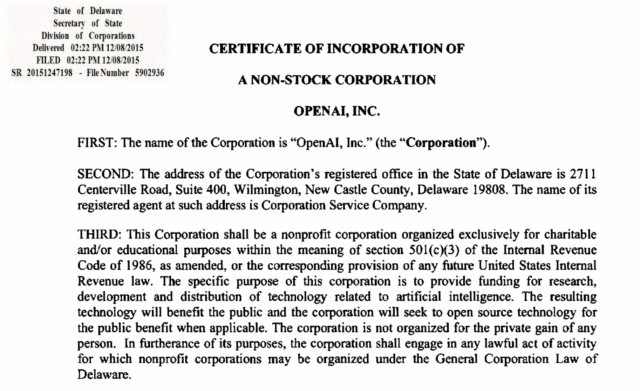
Profits and private gain were, at OpenAI’s early establishment, seen as in tension with its public mission. Found at SOURCE
The language is firm, almost austere. The corporation, the charter says, is not organized for the private gain of any person. The point is repeated in next articles, in slightly different terms: its property is “irrevocably dedicated” to advancing safe artificial-intelligence research, and “no part of the net income or assets … shall ever inure to the benefit of any director, … or to the benefit of any private person.” [emphasis added]
The founding announcement made much the same promise, though in a lighter register. “We’re hoping to grow OpenAI into such an institution,” it said. “As a non-profit, our aim is to build value for everyone rather than shareholders.”
Even two years after incorporation, Altman sounded much the same. In a 2017 interview, he was direct: “We’re a nonprofit: we don’t ever want to be making decisions to benefit shareholders. The only people we want to be accountable to is humanity as a whole.”
The worry was simple. Once profit enters the picture, shareholder demands could pull the company away from its founding mission to build safe Artificial General Intelligence, or AGI, AI that surpasses human intelligence.
III. “Some of the Benefits of Capitalism” are good
Then, around 2019, the tone begins to shift. Altman explained that efforts to raise enough money as a nonprofit had fallen short, and that the organization no longer saw a path forward on that model alone. The answer was to draw on “some of the benefits of capitalism—but not too much.”
By 2019, the limits of the nonprofit model were becoming harder to ignore. The scale of the project had grown quickly, and with it the cost. As OpenAI put it at the time, “We’ll need to invest billions of dollars in the years ahead.” For this reason, in 2019, OpenAI completed its first corporate restructuring. They created a for profit arm to attract investment, but kept control in the hands of the original nonprofit, which remained tied to the broader mission. Returns for investors were capped, and the structure was designed so that ownership and control would not fully align.
But even this experiment with “some capitalism” proved less than enough. The balance he had in mind began, over time, to shift, a change that would become clearer with the second restructuring completed last October.
By May 2025, in a letter to employees, Altman wrote that “instead of our current complex capped-profit, we are moving to a normal capital structure where everyone has stock. This is not a sale, but a change of structure to something simpler.”
Some former employees saw it differently. Represented by Harvard Law School Professor Lawrence Lessig, they filed an amicus brief in the Northern District of California, urging the court to take seriously the constraints of OpenAI’s original nonprofit form and suggesting that the change was not merely structural, but raised deeper questions about the limits of mission drift. Elon Musk had previously sued OpenAI, alleging that it abandoned its nonprofit commitment and thereby breached its fiduciary duties.
How does one move from believing that profit and mission are fundamentally in tension to thinking they can comfortably coexist?
A few months later, in October 2025, OpenAI, having secured approval from the Attorneys General of Delaware and California, reorganized as a for-profit public benefit corporation, a move framed as necessary to unlock the capital required to build AI for humanity. The structure that emerged is a hybrid. A new Public Benefit Corporation conducts OpenAI’s operations and raises capital, while the nonprofit retains a narrower set of oversight powers. In particular, it can appoint and remove directors and must be given a decisive role in safety and security decisions, where the mission is meant to take priority. Outside those domains, however, directors are left to balance mission and shareholder interests and much depends on how that balance is struck in practice. [Latsonas_3]
OpenAI’s website describes its nonprofit and for-profit structure as working together to advance its mission. Found in SOURCE
You might be wondering who are the investors and shareholders? Microsoft holds roughly 27% of OpenAI Group, and the remaining 47% is held by current and former employees and other investors. The rest is owned by the non-profit OpenAI Foundation.
How does one move from believing that profit and mission are fundamentally in tension to thinking they can comfortably coexist? How do shareholder profits, once seen as a threat, become part of the solution? Is it the same puzzle as Ben, who once insisted that only a vegan life could save humanity, until, one day, he comes to believe that, with a few adjustments, he can do just as much good while eating steak?
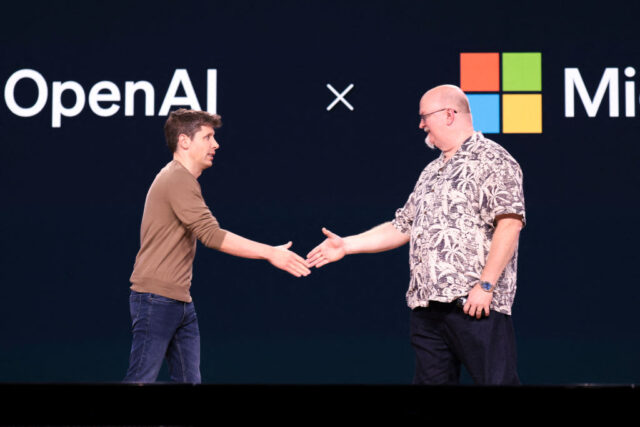
OpenAI CEO Sam Altman (L) shakes hands with Microsoft Chief Technology Officer and Executive VP of Artificial Intelligence Kevin Scott during the Microsoft Build conference at the Seattle Convention Center Summit Building in Seattle, Washington on May 21, 2024. (Photo by Jason Redmond / AFP) (Photo by JASON REDMOND/AFP via Getty Images)
A philosopher would be tempted to dwell on what happened here—whether the transformation reflects a shift in values, a transformation in what one takes herself to know about the world, or a deeper reconfiguration of identity.
IV. Three Corporate Forms
Corporate law, however, offers a far more prosaic answer. You can save both save the world and make your shareholders happy with profits. Just incorporate a Public Benefit Corporation!
A. Public Benefit Corporation
Under Delaware law, the Public Benefit Corporation is designed to square the circle: a profit-making company that also serves the public good. Directors are instructed to balance “the stockholders’ pecuniary interests” and the public benefits set out in its charter, without being required to put any of them first. For now, I want to juxtapose the Public Benefit Corporation with the nonprofit corporation and the traditional for-profit corporation.
B. Non-Profit Corporation
The nonprofit form is defined, at least in part, by what it excludes. The nonprofit has no owners and no profits to distribute to private individuals. As a recent restatement of the law explains, “the word ‘nonprofit,’ as opposed to ‘for-profit,’ connotes that the organization cannot have shareholders or members who are entitled to any distribution of its assets, profits, or earnings, thereby meeting the requirement…of a charity that there be no impermissible private benefit.” This is the same language OpenAI used to describe itself in its early emails, its founding announcement, its charter, and later interviews, all of which framed the organization in those terms.

Photo for YouTube. Found at SOURCE
Think of it like your friend who decides to cycle the length of Japan to raise money to save a local library from closing. Whatever money people donate is not hers. If she makes any money out of this trip, she cannot keep it or redirect it for her own or others’ benefit. She is entrusted with it for a specific purpose, to save the library, and those who donate do so on the understanding that it will be used accordingly. Whether she raises a little or a lot, none of it becomes his. Of course, she may deduct the costs of the trip, but nothing more.
But scale has a way of pressing on that arrangement. If the goal shifts from saving a small-town reading room to something like the Harvard Law Library, the need for funding changes, and with it the kinds of choices that seem available. At the same time, the law draws its own limits. Donors and intended beneficiaries cannot go to court to demand that the money be used in the way they expected or that they personally benefit. Oversight rests largely with attorneys general, leaving a gap between the expectations attached to a charitable purpose and the mechanisms available to enforce it.
C. For-Profit Corporation
Change one feature of the story. Imagine your friend is no longer cycling to save the library. Instead, she is organizing the same journey on behalf of a group of people who have funded the trip and will keep whatever money is left after the costs are covered. He turns the trip into an event, selling media rights, and building an audience around the journey. The aim is to generate as much surplus as possible for them. A traditional for-profit corporation has this single aim: to maximize the profits of its stockholders.
V. The Moment of Choice
What happens with a Public Benefit Corporation is that your friend is trying to do both at once. She is still trying to save the library, but he has also promised her funders that they will make money from the trip. Every dollar she allocates to the library is a dollar not returned to them. Every effort to increase profits risks diverting resources away from the very cause that justified the project in the first place.
Courts in Delaware have not yet defined what that balance requires. In the absence of case-law, PBCs will benefit from the favorable perception of the PBC form while continuing to prioritize shareholders.
At some point, she must decide: does she donate the extra revenue to the library, or distribute it to those who financed her? She cannot fully do both. To favor one is, inevitably, to disappoint the other.
This is the position of the Public Benefit Corporation. Delaware law tells her to “balance” these competing aims.
What that means in practice is less obvious. This is because the courts in Delaware have not yet defined what that balance requires. In the absence of case-law, PBCs will benefit from the favorable perception of the PBC form while continuing to prioritize shareholders.
Take OpenAI. It says it wants to build safe AI for the benefit of humanity. It also now has investors who expect a return. Perhaps there is no real conflict. Capital, after all, makes the mission to make safe AI possible. Without it, there is no large-scale research, no infrastructure, no race to build anything at all. On this view, profit is not the problem; it is part of the solution.
And yet, not long ago, OpenAI seemed to take a different view. The worry then was not just that profit might interfere with the mission, but that it would. That the incentives of shareholders and the demands of safety would, at some point, come apart—and that when they did, the wrong side might win. Building safe AI is significantly more expensive than developing untested and potentially dangerous systems.
This is what makes the shift hard to ignore. It is not simply that OpenAI now thinks it can do both. You might wonder, at this point, whether the ambition itself is doing too much work. On one view, “it is arguable that, despite the rhetoric of public benefit contained in the orthodox benefit corporation model, the directors of a benefit corporation will follow the power … will ultimately serve the private interests of the shareholders rather than some broad social good.”
I asked Greg Curtis about his views on the public benefit corporation model. Greg is the Executive Director of Holdfast Collective, Patagonia’s nonprofit shareholder, and Patagonia is widely considered one of the most successful public benefit corporations. He shared a similar concern. The Public Benefit Corporation form can slip into “greenwashing completely,” allowing companies to “make people think that the company is doing good” while still “operating a business as usual.” It also, he noted, provides a lot of discretion to boards and management, leaving them with considerable leeway not only in how they run the business but in how they “self-report to shareholders” on whether those benefit purposes are being met. One of his worries is that the public benefit corporation form introduces too much ambiguity into fiduciary duties, giving boards and management the ability to invoke multiple competing aims while insulating their decisions from real scrutiny.
VI. Fiduciary Duty to Humanity
What, exactly, does it mean then for OpenAI’s current charter to say that “our primary fiduciary duty is to humanity”? This duty is further explained as a commitment to use any influence the corporations obtains over AGI’s deployment to ensure it is used “for the benefit of all”, and to avoid enabling uses of AGI “that harm humanity or unduly concentrate power.”
It is indeed, at first glance, a strange thing for a corporation to say that it aims to save, or at least protect, humanity. In a Reddit thread titled “Did you know that OpenAI has a fiduciary duty to humanity, not to Microsoft shareholders?”, one user replied, simply, “typical corporate bs.”
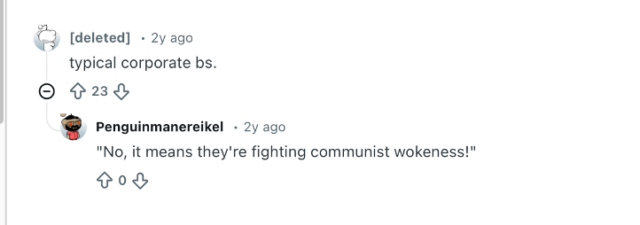
Screenshot of a Reddit thread discussing corporate claims. Found at Reddit.
The comment is offhand, but it is not entirely off. It captures a broader legal concern that claims like this may be more statements of aspiration than enforceable obligations.
To claim a duty to save humanity carries a faint sense of science fiction, as if a catastrophe were already on the horizon and someone had quietly taken responsibility for stopping it. You may reasonably doubt whether any private actor, however ambitious or well resourced, could actually deliver on such a promise. And you may also reasonably doubt whether corporate law and corporate forms can do anything meaningful for this.
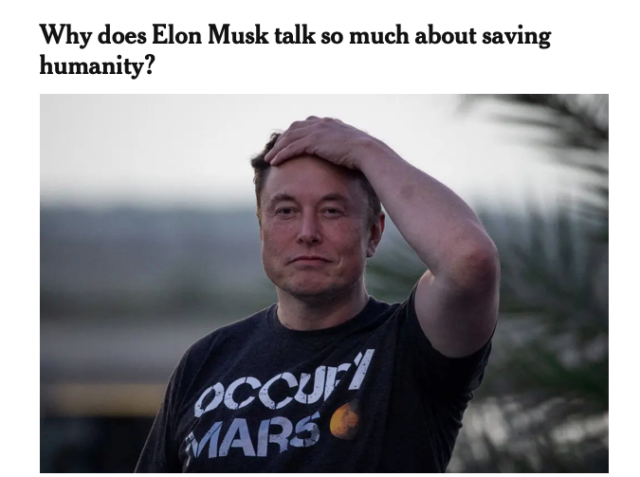
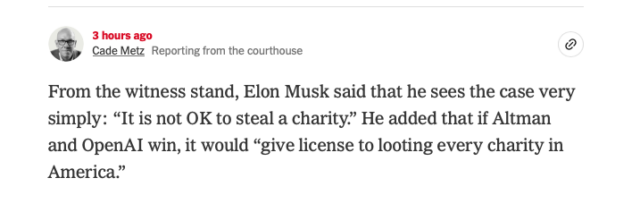
Screenshot of an NY Times article on the ongoing litigation between Musk and OpenAI where Musk and his lawyers repeatedly mentioned his mission to save humanity for extinction. The trial judge asked him to stop addressing this issue. Photo by Adrees Latif / Reuters. Found in SOURCE.
The more interesting question is not whether they can do it, but what they have committed themselves to. Does this language create legal obligations, or is it closer to a moral position that guides conduct without binding it—something like Ben’s commitment to veganism, where departure carries no legal consequence?
To see what the law requires when one undertakes to act for the benefit of another, and to understand the punctilio in the title, it is worth pausing here for a moment.
VII. The Punctilio
In Meinhard v. Salmon, two young New Yorkers merged their talent and money to lease and develop an old property in an enterprise. As the lease was coming to an end, Salmon was offered a new, more valuable opportunity by the landlord. He took it for himself, without informing Meinhard. The court held that this was a breach of fiduciary duty. Because the opportunity arose out of the partnership, Salmon was required to disclose it and allow his partner to share in it.
It is hard to see how OpenAI’s fiduciary duty to “humanity,” in its breadth, can constrain, discipline, or bind at all.
It was in that context that Cardozo, then a judge on the New York Court of Appeals and later a Supreme Court Justice, described fiduciary duties as requiring the “punctilio of an honor the most sensitive,” a line that has since become one of the most famous statements of fiduciary duty in American law.
“Punctilio” here has a meaning like strict, precise, and uncompromising.
We are not dealing here with a partnership. Still, the point carries over. When the law imposes a duty to act for the benefit of others, it is not something to be taken lightly or treated as merely symbolic. It is meant to constrain, to discipline, to bind.
It is hard to see how OpenAI’s fiduciary duty to “humanity,” in its breadth, can constrain, discipline, or bind at all.
Does this mean that OpenAI’s commitment is, in practice, unenforceable?
VIII. Who Enforces the Duty?
And, who, if anyone, can make sure that OpenAI lives up to its commitment to “humanity”?
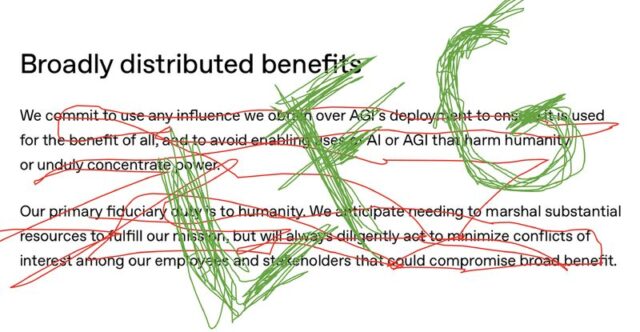
OpenAI’s statement on “broadly distributed benefits,” marked up to erase language about benefiting humanity critising the for-profit restructure. Found on LinkedIn.
Under a longstanding rule of English common law that the Crown oversees public interest, the role falls primarily to state Attorneys General, who exercises general oversight over nonprofit and public benefit corporations.
If OpenAI were to deviate from its purported fiduciary duty to “humanity,” enforcement would not lie with diffuse beneficiaries, but with public officials. In particular, under Delaware law, the Attorney General of Delaware (where OpenAI’s PBC and nonprofit are incorporated) could, in principle, intervene and bring suit. Shareholders may also bring a derivative suit against directors who fail to adequately take into account the public benefit factors relevant to the PBC’s stated purpose.
In fact, attorneys general have not been indifferent to OpenAI’s turn toward a for-profit structure. Both the California and Delaware attorneys general have been in prolonged negotiations with OpenAI over its restructuring. These negotiations led to an agreement after the attorneys general raised the possibility of blocking the transition to a public benefit corporation due to concerns about the preservation of its charitable mission.
Delaware Attorney General Kathy Jennings, addressing the restructuring, made clear that her office stands ready to act: “Anyone who is familiar with our work knows we are not shy to go into the courtroom to benefit the public if we need to.”