Courting Corruption
The Supreme Court’s Scheme to Delegitimize and Deter Democracy
Troy Brown
May 18, 2026
“So much has been done, exclaimed the soul of Frankenstein—more, far more, will I achieve; treading in the steps already marked, I will pioneer a new way, explore unknown powers, and unfold to the world the deepest mysteries”
– Mary Shelley, Frankenstein
“He showed unparalleled malignity and selfishness in evil; he destroyed my friends; he devoted to destruction beings who possessed exquisite sensations, happiness, and wisdom; nor do I know where this thirst for vengeance may end…. The task of his destruction was mine, but I have failed.”
– Mary Shelley, Frankenstein
![scales - Logo for The [F]law](https://theflaw.org/wp-content/uploads/2022/07/flaw_scale_divider.png)
JOHN ROBERTS must have seen this moment coming. As he sat in the House Chamber in early March, listening to Donald Trump tout the work he and his temporary co-President, Elon Musk, had been engaged in to demolish and strip the machinery of American government for parts, it’s impossible to know what Chief Justice Roberts thought. But he should have known he was responsible.
Eight months earlier, in Trump v. U.S., Roberts had penned what may go down as one of the worst Supreme Court decisions in history, declaring that Presidents, for all intents and purposes, are above the law. It was a breathtaking decision—notable as much for its incoherence as its explicit rejection of a fundamental principle of democracies: that all are equal before the law. But if Roberts’s opinion broke with American history, it was of a piece with his own history.
Since taking the reins of the Supreme Court in 2005, one of the most striking features of John Roberts’s tenure has been the Court’s willingness—if not outright determination—to court corruption. At the same time the Court has hammered away at political checks designed to keep American democracy running and responsive, if imperfectly, to the will of the people, the Court has all but eliminated the final check on political malfeasance: criminal anti-corruption statutes. This has had consequences that are all too real. Just like elections in our era of dark, corporate money, elected officials themselves are now up for sale. We are living in a renaissance of corruption, and that’s not by accident.
Just like elections in our era of dark, corporate money, elected officials themselves are now up for sale.
The most remarkable thing about the state of corruption in American politics today isn’t the extent—which is, predictably, immense—but the shamelessness. Consider the past year alone. Throughout the 2024 election cycle, Elon Musk—the world’s wealthiest person—spent more than a quarter billion dollars to help pave the way for the election of Donald Trump. It was, in the truest sense of the word, an investment. But even worse, it was an investment that has paid off. Since Donald Trump took office in January, Musk has cashed in.
As the head of DOGE, Elon Musk has directed an annihilation of American government. He has hung like the Sword of Damocles over any and all government entities and actions that threaten his wealth or power. Maybe this explains why Musk’s SpaceX is poised to receive “billions of dollars in new business” from the Pentagon under the Trump Administration’s proposed budget. Maybe this explains why the 35 methane gas turbines in Memphis, Tennessee—used to power Musk’s AI company, xAI, which have been spewing toxic pollutants like Nitrogen Oxide and formaldehyde into the air in an overwhelmingly Black neighborhood—aren’t currently being regulated by the EPA. And maybe this explains why DOGE has taken an interest in demolishing financial regulators like the SEC or CFPB that oversee work done by Musk’s companies.
Or maybe the machinery of government has just seen the light, recognizing the competence, genius, and infallibility of a man who once bragged about how his new vehicle’s windows were bulletproof immediately before those windows were shattered with the throw of a metal ball—presumably at a slower speed than a bullet. Who can say!
What we can say, though, is that Elon Musk represents everything that Chief Justice Roberts and the conservative legal movement have been fighting for. And in that sense, Musk is not unique; his corruption might be “breathtaking [in] scope and scale,” but it is not materially different from the corruption that defines American politics today.
In the last Congress alone, three members of Congress were charged with corruption-related crimes. Rep. George Santos pleaded guilty to funneling campaign money into his personal bank account. Rep. Henry Cuellar and his wife were indicted on federal bribery charges for allegedly accepting roughly $600,000 in bribes from the Azerbaijani government in exchange for influencing U.S. foreign policy in Azerbaijan’s favor. And Sen. Robert Menendez accepted literal gold bars—in addition to nearly a half-million dollars in cash and a Mercedes-Benz convertible—from the Egyptian government as part of an illicit deal to influence American policy on Egypt’s behalf.
Still, what’s most remarkable isn’t that there were three corrupt members of Congress, but that there were three prosecutions of corrupt members of Congress. Because, since joining the Court, Roberts and his predominantly conservative colleagues have made it their mission to use their power as, in the words of Roberts, “unelected, politically unaccountable judges,” to remake the United States in the Court’s image. And so far, he has succeeded.
What began in 2010 as an effort to make elections less about the will of the people and more about the will of the wealthy has morphed into a jurisprudence of elite impunity. In a series of cases starting with 2016’s McDonnell v. U.S., Roberts and his colleagues have done everything in their power to insulate elected officials from accountability; chipping away at the criminal prohibitions against public corruption. And though the themes of the Court’s public corruption jurisprudence mirror those of the Court’s money in politics caselaw, public corruption hasn’t captured the public imagination in the same way.
Still, the two lines of caselaw are two sides of the same coin—complementary schemes to deter and delegitimize democracy. In the words of David Pepper, who previously served as the Chair of the Ohio Democratic Party, “the corruption is endemic to the attack on democracy.”
If there is any lesson to be learned from American history, it’s that courts are fallible, and laws are mutable.
As conservatives have come to dominate the Supreme Court, the touchstone of American legal thought has become “history and tradition”—that is, courts ask whether a certain right, practice, or prohibition is “deeply rooted in this Nation’s history and tradition” in order to decide if it’s constitutional. In recent years, this decidedly dubious jurisprudential approach has been used to strike down gun control regulations from the turn of the 20th century, to end the federal right to abortions, and to demolish the separation of church and state. It is, in short, little more than conservative legal thought dressed up in historical garb.
But even accepting the premise that this is a legitimate way to govern a country (it’s not), history and tradition, it turns out, can cut both ways. Because if there is anything Americans across time and space hate, it’s politicians on the take. As history makes clear, cramped legal definitions of corruption don’t dictate the bounds of corruption, people do. And if there is any lesson to be learned from American history, it’s that courts are fallible, and laws are mutable.
Though not a uniquely American phenomenon, political corruption is profoundly American. As legal scholars Matthew Stephenson and Mariano-Florentino Cuellar have written, “Political corruption was widespread in the American colonies before the Revolution, and pervaded American politics from the beginning of the Republic.”
Widespread corruption was certainly the case in 1790’s Georgia, which saw the fledgling United States’s first massive bribery scandal. With westward expansion—and its accompanying dispossession of land from the Creeks, Cherokees, and other native Indian tribes—picking up steam in Georgia, the land trade in then-western Georgia was growing increasingly lucrative. And for Georgia’s legislature, the allure of riches was too enticing to pass up. In what came to be known as the Yazoo land fraud, Georgia state legislators struck a deal with four private land companies, selling 35 million acres of land—almost the entirety of what today is the state of Mississippi—for $500,000 (less than $0.02/acre).
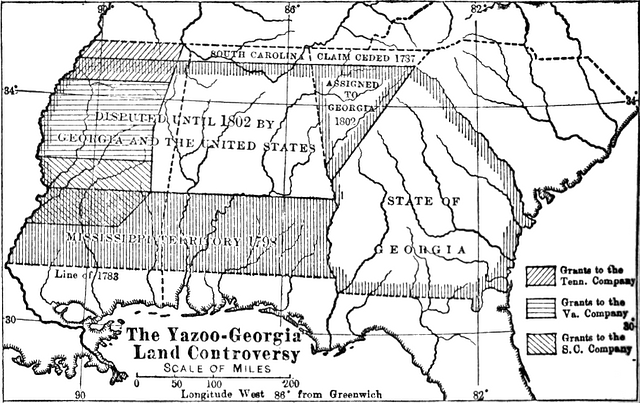
Yazoo-Georgia Land Controversy used under Creative Commons License
To grease the wheels of this sweetheart deal, the land companies bribed all but two members of the state legislature. And to make matters worse, nothing the companies or the legislature had done was illegal. At the time of the Yazoo scandal, there was no statute in Georgia outlawing bribery. Still, consequences for the corrupt legislators were swift. Voters’ outrage at the legislature’s corruption prompted a massive turnover in the composition of the legislature following the next year’s elections. It was an early lesson for both the public and politicians that where there is power, there will always be people who try to exploit it. But where power is exploited, there will always be people determined to fight back. It’s a lesson whose echoes we continue to hear today.
As the 18th Century turned to the 19th, the United States underwent expansion and convulsion. But corruption—and efforts to stamp it out—continued apace. In the words of historian Robert Remini, during the early part of the 19th century “many men in Washington regularly plundered the treasury…. Those who disbursed funds or otherwise handled public money skimmed off a little something for themselves as a regular matter.”
As the century progressed, corruption worsened. With the rise of Andrew Jackson came the formalization—and explicit legalization—of corruption. The establishment of the spoils system allowed presidents to dole out favors in exchange for fealty. As Stephenson and Cuellar detail, “In 1858, a local newspaper editor who visited Washington, D.C. wrote that he was shocked by the brazen and routinized buying and selling of offices carried out by party leaders in the U.S. Senate, the White House, and various government departments, with ‘the actual sum of money to be paid for an office … as publicly named … as the prices of dry goods are named between a dealer … and his customers.’” Predictably, the rampant corruption in the federal government extended to “the administration of justice,” which British politician Henry George Gray, 3rd Earl Gray, described as being “infected with the taint [of corruption].”
Where there is power, there will always be people who try to exploit it. But where power is exploited, there will always be people determined to fight back.
But if the corruption of the American government in the early parts of the 19th century might best be described as everyday, the corruption that marked the end of the century was extraordinary. Corruption, from the position of elected officials and public servants on the take alike, became about more than receiving favors; it was about making fortunes.
In expanding the scope of corruption, politicians and powerbrokers on the take sowed the seeds of their own demise. During the 1860s, Boss Tweed, the leader of New York City’s Tammany Hall political machine incorporated his own form of spoils, enriching himself in the process. In the telling of Stephenson and Cuellar, “Between 1867 and 1871, [Tweed] and his cronies stole somewhere between $40 million and $410 million from New York City’s public coffers.” But “[w]hen the scale of this theft was disclosed in 1871 by a rival politician who had managed to get hold of the city’s account books and leaked them a newspaper, Tweed’s ring collapsed and Tweed himself went to jail, where he died in 1878.”
Still, this era of rampant corruption could not last. In the 1850s, the federal government began to pass its first anti-corruption laws and rules—banning the bribing of Members of Congress and preventing its Members from acting as paid lobbyists. Though modest in scope—and even more paltry in enforcement—these enactments were noteworthy breaks from the laissez-faire approach to corruption that had defined most of the first century of the American experiment. As the 19th century wound to a close, federal officials began to be forced by public pressure into supporting anti-corruption measures and stances, even if their private positions differed sharply. And with the turn to the 20th century, the dam broke.
Across the country, civil service reforms were adopted at both the state and federal levels. Underlying these civil service reforms was the idea of meritocracy—the idea that ability, not connections, should determine success. But even more powerful was the fact that civil service reform was democratic. As Robert Caro puts it, “What good were campaigns to change the government, if the people running it, administering its machinery, were still the same unqualified, inefficient, indifferent political hacks?”
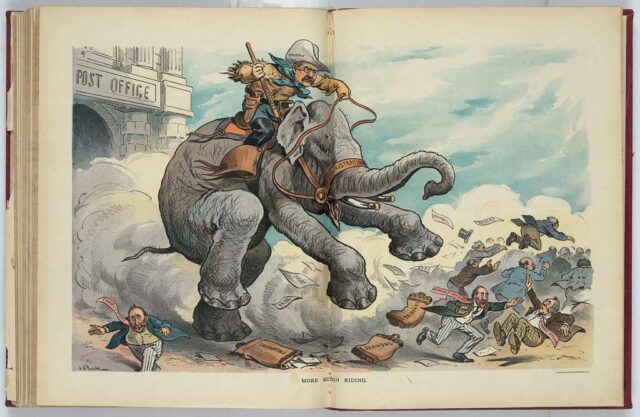
More Rough Riding. J.S. Pughe, 1903
At the same time, to curb the influence of money and undue influence in politics, reforms like standardized, secret ballots were adopted. And during the administration of Teddy Roosevelt, the federal government began to crack down on corruption, indicting hundreds of people in the government for violating criminal anti-corruption laws.
While the Roosevelt Administration was fighting corruption in government, it was simultaneously taking on corporate power. It was a fight that took two different forms. In 1902, the Roosevelt Administration started using the then-dormant Sherman Antitrust Act to break up the corporate conglomerates that defined the Gilded Age, limiting their power in the market. But the administration also took on corporate political power, pushing through Congress the first campaign finance reform statutes in American history. And while, as Zephyr Teachout notes, these laws “were notoriously weakly enforced, they caused a shift in the amount—and source—of money spent in campaigns after they passed.” It was, Teachout writes, an explicit acknowledgment “that private concentrated power…could systemically corrupt politics.”
Big money, however, would not go down without a fight. And so, it turned to a reliable ally: the courts. In 1921, the Supreme Court struck down a law limiting the amount of money congressional candidates could spend on primary elections. But as the political tides turned against business in the wake of the Great Depression, so too did the Court’s appetite for rolling back anti-corruption laws. Addressing Congress a year after his threat to pack the Supreme Court prompted the Court to reverse its anti-egalitarian opposition to the New Deal, Franklin Roosevelt made clear the hard-learned lessons of generations of Americans who came before him, explaining that “the liberty of a democracy is not safe if the people tolerate the growth of private power to a point where it becomes stronger than their democratic state itself.”
Still, big business had learned a lesson of its own: the courts, by virtue of their relative insulation from political pressures, could be a friendly forum to avoid democratic accountability. In 1976, the lesson—dormant but not forgotten—would finally be put to use.
In the wake of Watergate, Congress cracked down on corruption. Amending the Federal Election Campaign Act in 1974, the new-and-improved FECA imposed mandatory contribution disclosure requirements and criminalized campaign contributions and expenditures over specified limits. Within two years, a challenge to FECA made its way to the Supreme Court. In the longest set of Supreme Court opinions ever written, the Court in Buckley v. Valeo upheld most of FECA. But in doing so, the Court struck down the statute’s expenditure limit. The amount of money campaigns spend, the Court held, cannot be limited; to allow such a limit would violate the First Amendment. Money was now speech—or, at least, that was the story the Supreme Court began to tell.
The ramifications of Buckley are well-documented. Once John Roberts sat at the helm of the Court, the logic of Buckley was extended in Citizens United, which struck down limits on corporate campaign contributions. And Citizens United led, in turn, to McCutcheon v. FEC, in which the Court held that aggregate campaign contribution limits were unconstitutional. But as the Court became more comfortable with money in politics, it grew, predictably, less comfortable with anti-corruption laws.
As the Court became more comfortable with money in politics, it grew, predictably, less comfortable with anti-corruption laws.
In 1999, the Court took its first, modest swing at federal criminal public corruption laws. Under federal law, public corruption is split into two different categories: bribes and gratuities. The key distinction between them is when the payoff for corruption happens. Bribery is corruption as it’s typically thought of—buying favor for future action. By contrast, gratuities are payoffs for favors already done; a public official took some action and was rewarded for it after the fact.
By their very definition, gratuities are a more difficult form of corruption to crack down on. Who’s to say if a gift to a city counselor was unrelated to their official work or not. And so, in U.S. v. Sun Diamond Growers of California, a unanimous Supreme Court held that gratuities—call them gifts—are illegal only when prosecutors can “prove a link between a thing of value conferred upon a public official and a specific ‘official act’ for or because of which it was given.” It was a narrow limit on prosecutorial power, but its implications were far-reaching.
Underlying the Court’s decision was the idea that some corruption should be legal. In reaching its conclusion, the Court noted that a broad interpretation of anti-corruption law would stop people from giving public officials gifts “because of [their] official position perhaps, for example, to build a reservoir of goodwill that might ultimately affect one or more of a multitude of unspecified acts, now and in the future.” But that is exactly what public corruption laws are designed to stop. Holding public office shouldn’t be a means to riches. Public officials shouldn’t be able to put themselves up for sale to the highest bidder based on a legal technicality—selling vague future influence instead of a single, specific corrupt act in the here and now.
Public officials shouldn’t be able to put themselves up for sale to the highest bidder based on a legal technicality—selling vague future influence instead of a single, specific corrupt act in the here and now.
Once John Roberts took his seat as Chief Justice, he took the Court’s permissive approach to corruption and ran with it. In 2016 in McDonnell v. U.S., Roberts, writing for a unanimous Court, overturned the corruption conviction of former Virginia Governor Bob McDonnell. As Governor, McDonnell had used his office to try to repay his billionaire benefactor who had helped get him elected.
After accepting private flights and more than $175,000 in gifts and loans from Virginia businessman Jonnie Williams, McDonnell pressured state university employees to perform studies on a product Williams was developing so that it could be brought to market. At a minimum, Roberts conceded, the case was “distasteful,” but he went on to note, “our concern is not with tawdry tales of Ferraris, Rolexes, and ball gowns.” Indeed, it was not.
Adopting a cramped reading of what constitutes an “official act,” Roberts and the Court held that official acts require “a formal exercise of governmental power that is similar in nature to a lawsuit before a court, a determination before an agency, or a hearing before a committee; it must also be something specific and focused that is pending or may by law be brought before a public official.” In reaching this conclusion, the Court claimed that unofficial corruption—including things like granting special access to billionaire benefactors or informally pressuring public servants to take actions they wouldn’t otherwise take—are not only allowed, but a central part of how government works, representing “the basic compact underlying representative government.” Here, Roberts and the Court were telling on themselves, as would come to light in subsequent years.
Given the Court’s own appetite for corruption, which fittingly includes various trips on private jets funded by the Court’s—as opposed to McDonnell’s—billionaire benefactors, the decision in McDonnell was anything but surprising. But what is surprising about the Court’s determination to keep public officials unaccountable is just how transparently they have gone about it.
In the years after McDonnell, the Court continued to chip away at criminal public corruption statutes. In Snyder v. Phelps, the Court overturned the corruption conviction of an Indiana Mayor, James Synder. Snyder had been indicted and found guilty for soliciting and receiving a payment of $13,000 in exchange for funneling a city contract to a local car dealership. It was corruption plain and simple. But not for the Court. Writing for the majority, Justice Kavanaugh, ignoring the statutory text, history, and purpose, held that federal law does not “regulate gratuities to state and local officials.” It was of a piece with the Court’s belief that power should not be held to account. But if Snyder was bad, what was coming was worse.
Eight years after the Court adopted an artificially narrow conception of “official acts” in McDonnell, the Court interpreted the same phrase in Trump v. U.S. A phrase that the Court had once adamantly argued required “a more bounded interpretation,” became a sweeping grant of immunity. Once again writing for the Court, Roberts held that, when it comes to the President, the term official acts “extends to the outer perimeter of the President’s official responsibilities, covering actions so long as they are not manifestly or palpably beyond [his] authority.” In dissent, Justice Sotomayor made clear just how radical the Court’s holding was, explaining that under the majority’s view of the law, “a President’s use of any official power for any purpose, even the most corrupt, is immune from prosecution.”
The Court’s decision on the law was egregiously wrong, but what was even more egregious was the Court’s shamelessness in reaching its decision. When a broad reading of the phrase “official acts” threatened the power of public officials, the Court interpreted the phrase narrowly. And when a narrow interpretation would allow public officials to be held accountable, the Court interpreted the phrase broadly. Call it a “heads I win, tails you lose” theory of law where the loser is always democracy.