Dragnet Surveillance by Design
Juvaria Shahid
July 8, 2026
In April 2024, Brandon Upchurch was driving his red Dodge Ram in Toledo, Ohio when a Flock Safety AI-camera misread his license plate and flagged his vehicle as stolen. Within minutes, a real-time alert was pushed to police officers, who drove to his location. The officers unleashed a K-9 dog on Upchurch, who was subsequently arrested.
He encountered Flock Safety, an integrated AI-powered surveillance platform that scans twenty billion vehicles per month, all in a matter of seconds.
After the baseless charges were dropped against him, Upchurch lost his job, sold his truck, was evicted from his home, and had to rehome his dogs because of the trauma. A federal judge, who approved a $35,000 settlement between Upchurch and the arresting officer, reportedly remarked that this was a case where “Flock Flocked up.”
Upchurch did not encounter a rogue officer who profiled him. He encountered Flock Safety, an integrated AI-powered surveillance platform that scans twenty billion vehicles per month, aggregates the data into a searchable nationwide database, runs it through AI that generates matches and alerts, and pushes those alerts to armed officers with routing instructions, all in a matter of seconds. Flock Safety is the most prominent example of a new category of private companies that power the physical infrastructure of law enforcement surveillance.
These companies do not merely assist police; they are building a unified surveillance architecture that, for the first time in American history, makes dragnet surveillance operationally achievable. Of course, ‘public-private partnerships’ (PPPs) for governmental surveillance are not a new concept. It dates back to wartime interceptions of telegrams and the mid-century monitoring of political dissidents, in which private telecommunications companies served as willing conduits for state intelligence.
However, the infrastructure of PPPs matured and quickly outgrew its national security origins after post-9/11.
Law enforcement officials discovered they could purchase consumer data from private data brokers without warrants. Meanwhile, technology companies discovered that the same digital tools developed for counterterrorism could be packaged and sold to local police departments to reduce crime, giving rise to a new generation of venture-capital-backed startups to quickly ship and place surveillance products on American streets. The result is the building of what I term the ‘surveillance supply chain’: a taxonomy of private companies that feed the government’s surveillance capacity.
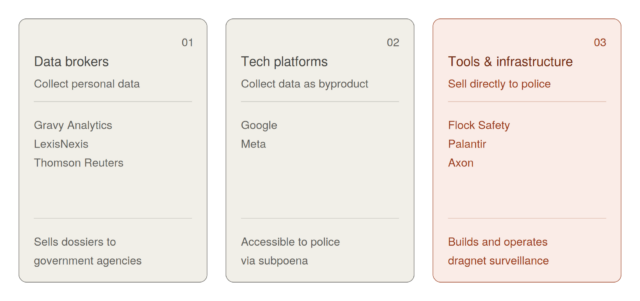
Visual Created by Juvaria Shahid.
The first category comprises of traditional data brokers that collect personal data from public records, consumer transactions, and other sources to create comprehensive ‘dossiers’ on individuals, which are often sold directly to government agencies. Even though recent years have seen a ramping up of state data broker laws and FTC enforcement to constrain the harms of illegitimate data collection, the data broker industry remains largely unregulated. The ‘Fourth Amendment Is Not For Sale Act,’ which would have restricted government purchases of personal data from brokers, passed the U.S. House in 2024 but was blocked in the Senate.
The second category contains companies whose primary business models generate vast quantities of surveillance-useful data as a byproduct, such as Google and Meta. These companies offer free digital services in exchange for collecting immense amounts of behavioral data not only to refine their products, but also to sell to third parties such as advertisers or data brokers, which in turn can hand that data to law enforcement.
The third category is composed of “enforcement tools and infrastructure” companies, such as Flock Safety, Palantir, SoundThinking, Axon, and Motorola Solutions. These companies manufacture and operate cameras, sensors and software systems that are leased to law enforcement agencies, and in some cases, to private entities such as homeowner associations. This rapidly-evolving category acts as the physical arm of the modern surveillance-industry complex in the United States, fueled by privately-held venture capital firms.
For example, Palantir’s Gotham platform, originally built for counterterrorism intelligence at the CIA, now serves domestic law enforcement agencies by integrating data from ALPR cameras, social media platforms, arrest records and commercial data brokers into one platform.
“It is no longer possible to say where corporate motive for profit ends and where state surveillance begins..”
Similarly, Flock Safety’s FlockOS platform integrates data from thousands of law enforcement agencies and private entities into a single shared intelligence network. Through it, participating departments can search any vehicle’s nationwide history without suspicion, identify cars by physical features like bumper stickers and dents, automatically deploy drones to track flagged vehicles, and merge real-time location data with police records to build searchable patterns of life and alert police to suspicious activity.
This third category poses two distinct dangers, the first being that it makes pervasive, ‘always-on’ surveillance operationally achievable. Data brokers can assemble dossiers, and social media platforms can collect behavioral data at scale, but neither can physically deploy cameras on public streets. Platforms like FlockOS, however, are designed to facilitate ‘dragnet surveillance,’ or the automated and comprehensive tracking of people’s movements, associations, and activities, conducted without individualized suspicion and meaningful human oversight.
Second, this category collapses the public/private divide entirely. While public and private surveillance have always “support[ed] each other in a complex manner that is often impossible to disentangle,” the tools-and-infrastructure category does not merely entangle them, it makes them indistinguishable. It is no longer possible to say where corporate motive for profit ends and where state surveillance begins when Flock’s primary investors donate Flock equipment to police departments or when Flock markets its product to both police departments and homeowner associations, creating what it calls a “public-private safety network.”
Eradicating Crime, One Camera at a Time
Corporations construct legitimacy through what Professor Jon Hanson calls a “stick and ball” framework. A “stick” is an actor responsible for their own choices, while a “ball” is an actor moved by external forces and therefore exempt from blame.
In the surveillance context, criminals are cast as sticks, or wrongdoers whose individual choices justify their being constantly surveilled. Flock and its investors cast themselves as balls, merely responding to the crime problem.
Flock’s mission is “to eliminate crime. Full stop.” Flock’s CEO, Garrett Langley, has argued publicly that “if you don’t feel safe, you won’t start a family…you won’t start a business…everything starts to fall apart”—positioning Flock as the only thing standing between the public and civilizational collapse.
Andreessen Horowitz, Flock’s lead investor, houses the company within what it calls its “American Dynamism” practice—a fund described as supporting “the national interest” through investments in defense, public safety, and infrastructure. The firm has called Flock part of a “superhero stack” of public-safety technologies, alongside drone fleets and command software, that together represent “the future of public safety.”
Nobody was asked about it. Nobody voted on it. And I think that’s fundamentally wrong.
Last fall, Ben Horowitz announced publicly that he and his wife had donated $6.3 million in Flock and Skydio equipment to the Las Vegas Metropolitan Police Department, framing the gift as “making the best technology available to the public sector” that “often has trouble budgeting for strategic technology projects.” The donation was routed through a tax-exempt police foundation, bypassing the city council that would otherwise have had a say.
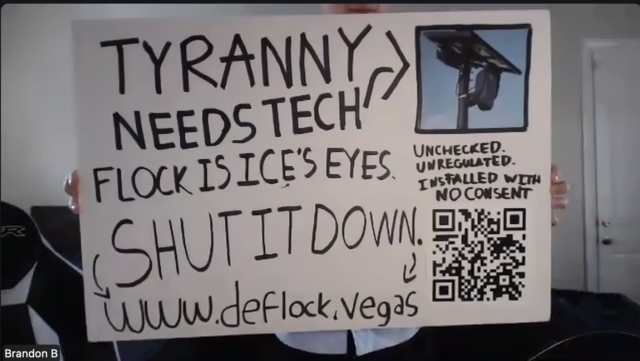
Brandon Bunce, a Las Vegas organizer at DeFlock Las Vegas, watched the cameras go up overnight. “October 2024, the money comes in. Ben Horowitz says, here you go. And these cameras just go up,” he recalled. “Nobody was asked about it. Nobody voted on it. And I think that’s fundamentally wrong.”
![[F]law School Episode 13: The Migrant Trap](https://theflaw.org/wp-content/uploads/2025/03/Drury_FB2-e1742192209662-640x427.png)