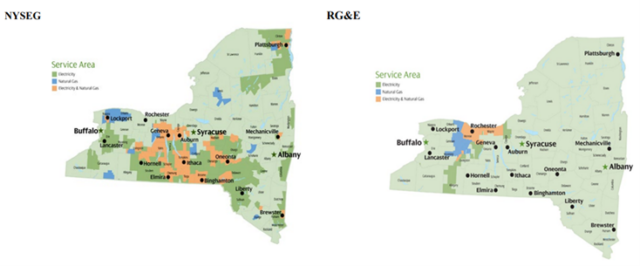
NYSEG and RG&E service territories. Published in Northstar audit.
The record now supplies an answer. In May 2023, the New York State Public Service Commission (“PSC”) initiated an audit to “shine a bright light on the ongoing billing issues and consumer complaints directed at NYSEG and RG&E.” In September 2023, the Commission selected Northstar Consulting Group to perform the audit. While the audit was underway, Iberdrola acquired Avangrid’s remaining minority shares, taking the company private and further narrowing the channels of public-facing transparency. Northstar’s audit, released in June 2025, shows that a lack of transparency is just one among many shortcomings plaguing the Iberdrola corporate family’s management of the grid serving Upstate New Yorkers.
To understand what has changed, consider a question any Buffalo Bills fan can answer: how many NFL teams play in New York? The answer, of course, is one. The Jets and Giants play in East Rutherford, New Jersey. But cheeky bit notwithstanding, no one seriously disputes that they are New York teams. An organization’s identity is more than its mailing address.
The future of Upstate New York’s grid is not being planned by New York institutions, but by a corporate parent several steps removed from the communities it serves.
RG&E and NYSEG present a similar quandary. Their wires run through New York communities. Their trucks bear New York utility nameplates. Their customers pay bills to companies that look local and had been for a century. But the Northstar audit makes plain that the substance of those institutions has quietly migrated out of New York and into Bilbao.
Despite whatever brand continuity the utility nameplates convey to ratepayers, Northstar found that “the presentation of NYSEG and RG&E corporate governance is misleading.” In practice, “RG&E and NYSEG do not govern or manage the finance, planning, engineering, customer service, operation, maintenance or resource allocation of the New York utilities. Those functions are performed by [Avangrid parent] companies.” In other words, the entities that ratepayers know as their local utilities are, in meaningful operational terms, shells.
And while corporate governance shuffled upward, strategic thinking disappeared almost entirely at the utility level: “Avangrid has a strategic planning process and resulting strategic plans. NYSEG and RG&E do not.” The future of Upstate New York’s grid is not being planned by New York institutions, but by a corporate parent several steps removed from the communities it serves.
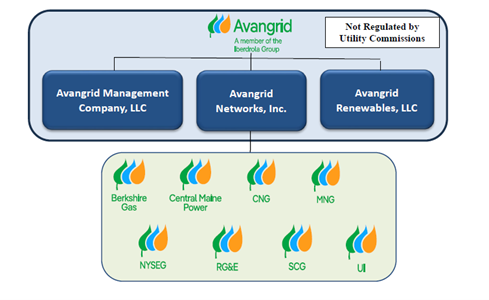
Avangrid corporate family. Published in Northstar audit.
Avangrid executives are sure to argue that the utilities’ shared governance across states and countries is consistent with the economies of scale that motivated the merger in the first place. Unfortunately, the companies’ insufficient accounting records obscure whether that possibility has been realized in practice. Plant accounting records were found to contain inaccurate unit cost information, rendering historic unit costs an unreliable metric for evaluating whether current projects are being delivered at reasonable prices. Auditors found anomalous data within plant records that directly distort those unit costs—including “significant assets with a quantity of zero” appearing in both companies’ books.
Cost allocations from the Avangrid parent companies to the New York utilities also present problems. Northstar found that “Avangrid service companies’ complexity prohibits transparency of allocated costs,” making it “difficult to determine if allocated charges to the New York utilities are based on cost causation”—a fundamental tenet of public utility ratemaking. Northstar requested cost-estimate documentation for selected electric and gas capital projects, only to find that Avangrid could not provide documentation supporting adherence to its own cost-estimate development procedures. More broadly, the audit found that Avangrid does not produce detailed cost estimates for NYSEG and RG&E capital projects at all. Ratepayers are being asked to fund infrastructure spending that the company neither rigorously estimates nor meaningfully documents.
Perhaps most troubling, given the scale of New York’s clean energy ambitions, is the audit’s portrait of Avangrid’s planning failures. New York has enacted some of the most aggressive climate legislation in the country through the Climate Leadership and Community Protection Act (“CLCPA”). Utilities are expected to be active participants in achieving its goals. Based on Northstar’s findings, NYSEG and RG&E are not. Avangrid’s 2022-plus strategic plan “does not address NYSEG’s and RG&E’s proportional energy efficiency savings or [disadvantaged community] investment goals and lacks specific, measurable targets.”
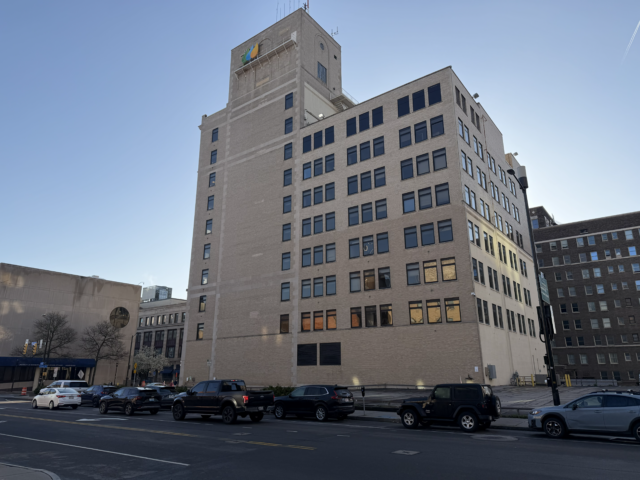
RG&E Building, Rochester, NY. Photo taken by Justin King.
The governance structure meant to fill that gap turns out not to exist, either. Avangrid represented to Northstar that New York regulatory matters are handled through a body called the Regulatory, Planning, Operations and Customer Council (RPOCC), with planning matters discussed by the utilities’ president at monthly meetings. Northstar investigated and found that “[i]n fact, this committee does not exist.”
Avangrid later clarified that the appropriate forum is actually called the New York President’s Leadership Meeting. Whatever that forum is, it leaves little trace. The meetings have agendas, but do not record minutes or produce meeting materials. A review of those agendas from 2022 to 2024 shows they address rate cases and financial matters, but “do not include specific NYSEG or RG&E goals, objectives or specifics related to CLCPA.” The state’s signature climate law is effectively invisible to the planning process of the utilities tasked with helping to implement it.
Even where the CLCPA has nominally been incorporated into forecasting, Northstar found the treatment inadequate. Building electrification—a cornerstone of decarbonizing New York’s housing stock—is almost entirely absent from Avangrid’s planning, with only a negligible amount included and limited to electric heat pumps alone; other fuel-switching opportunities, such as electric hot water heating and electric cooking, are not included. Similarly, distributed energy resource forecasts account for battery storage only in conjunction with solar installations, while standalone battery systems are ignored, despite their transformational potential for the grid. In a rapidly changing energy landscape, this planning posture is woefully insufficient.
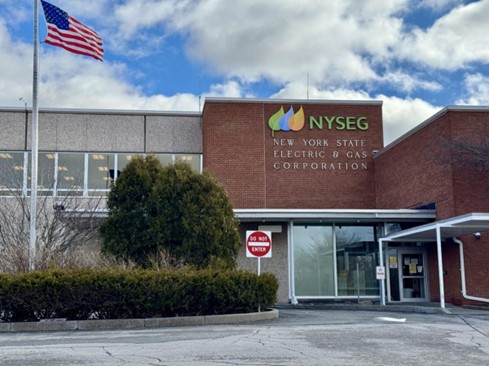
The New York State Electric & Gas Corporation Building in Auburn, NY. Photo taken by Justin King.
Not only are utility planning decisions at Avangrid substantively deficient, but the community lacks the power to respond to those deficiencies. Describing NYSEG’s effort to close physical offices in favor of telephone-based customer service, one Cayuga County legislator explained:
As a legislator for a rural county of just over 74,000 individuals in New York State, I have witnessed the engagement of constituents in the matter of increasing electrical and natural gas rates and decreasing access to personalized, local and direct customer care. In fact, well over 50 members of the public attended a public hearing in late 2025 regarding the proposed increases in rates and fees by NYSEG to be presented for consideration by the Public Service Commission for review and approval status. [T]he public who attended were well-versed in the overseas ownership of NYSEG and its implications for the invisibility of customer concerns over growing rate hikes. This same constituency also clearly noted why a local, public-facing office was critical to maintain—citing issues involving disadvantaged populations like the aged population, and poor and working poor who have little to no digital access for bill payment. Members of these populations continue to want and need direct assistance versus assistance through telephone-based customer service.
The problem is not simply that bills are high. It is that the people paying those bills often cannot identify a local decisionmaker with the power to respond.
That testimony captures the democratic deficit at the heart of the modern utility model. The problem is not simply that bills are high. It is that the people paying those bills often cannot identify a local decisionmaker with the power to respond. Their regulator may listen, but only within the narrow confines of a rate case. Their community may organize, but the grid’s capital plan remains largely someone else’s province.
Having documented a corporate family that obscures its costs, ignores its own procedures, misrepresents its governance structures, and plans inadequately for New York’s energy future, one might expect the audit to coincide with a period of restraint on the part of Avangrid’s New York subsidiaries. Instead, both utilities have filed for substantial rate increases. For the rate year ending April 30, 2027, NYSEG is requesting an increase in annual electric revenues of approximately $464.4 million—an 18.4 percent increase to total revenues—which it estimates would raise a typical residential customer’s monthly bill by $33.12, or 23.7 percent. RG&E, for its part, is requesting an increase in annual electric revenues of approximately $220.2 million, a 19.8 percent increase to total revenues, translating to a monthly bill increase of $33.01—26.0 percent—for a typical residential customer.
“Avangrid prioritizes corporate earnings, not the needs of NYSEG and RG&E.”
These are not modest adjustments. They are requests for massive rate increases from a company that has, by its own auditor’s account, failed to demonstrate that its current spending is properly accounted for, let alone responsive to the needs of the community. Simply put, “Avangrid prioritizes corporate earnings, not the needs of NYSEG and RG&E.”
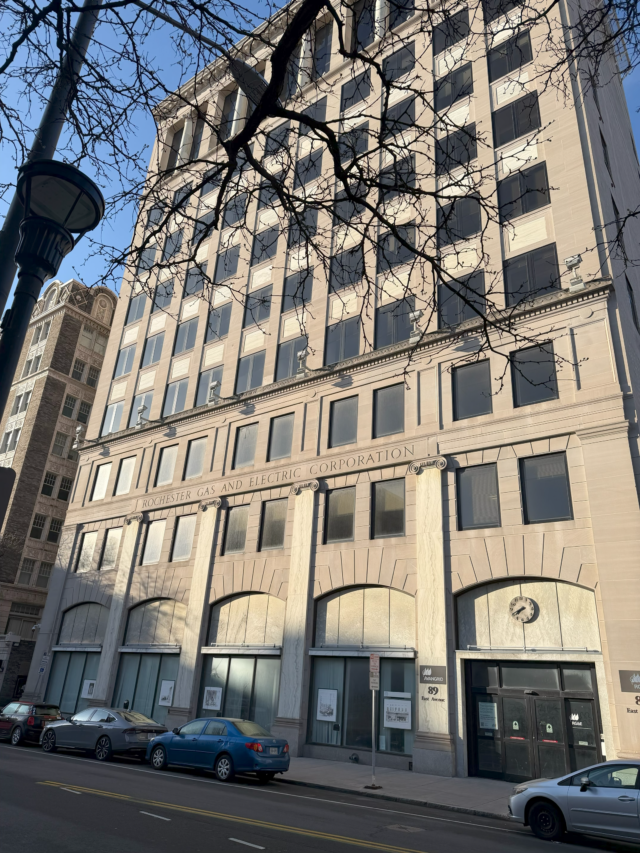
The morning sun shines across the front of the RG&E building in downtown Rochester.
2. Origins of Public Utility Governance
The early electricity industry was not born orderly. In the 1880s and 1890s, some of the era’s most vibrant personalities battled over the technological and political fate of electric service. In the famous “War of the Currents,” Thomas Edison advocated for the adoption of direct current (“DC”) over the purportedly more dangerous alternative: Nikola Tesla’s alternating current (“AC”) design. Tesla’s AC technology would ultimately win the day. But the business model that would shape the industry into the form we know today came from another figure in Edison’s orbit: Edison’s young assistant from England, Samuel Insull.
Insull embodied the sort of entrepreneurial success story that lay at the heart of the American dream. He traveled to America with the ambition of learning under the famous “wizard” of the electricity industry. Insull’s stint in New York as Edison’s right-hand man proved to be extraordinary training for his own lofty ambitions. Under Edison, Insull learned that electricity was not merely a technological marvel; it was a network business. Whoever controlled the wires would control the future of the industry.
Others understood this, too. Magnates such as Insull raced to build out their respective service territories, and competing wires traversed the same streets as turf wars raged across the most profitable, densely populated city centers. Competition, the organizing principle of American capitalism, looked increasingly wasteful when applied to a capital-intensive network.
In the electricity industry, the American ideal of free enterprise persists even in its absence and, much like the real thing, is dominated by its most well-resourced players.
Insull set out to resolve this inefficiency with several innovations that would prove foundational to the grid we know today. First, drawing from a lesson he learned from Edison’s earliest service strategies, Insull proposed that electricity generation be centralized in larger plants. “Central stations” achieved economies of scale that made them more efficient than individual dynamos—generators—installed in each house or business to be served. Once Insull found success with his central station model, he decided to leverage that success in the court of public opinion. Insull’s enterprising public relations manager, Bernard Mullaney, sent Insull on tour and widely distributed his speeches: the materials explained how “incredibly brilliant and successful Insull had become. Nearly every speech would include how central station power made everyone’s life better, created jobs, paid taxes, and made the U.S. a great place to live.”
Insull’s second lasting innovation proved equally decisive in securing dominance over the industry. Insull shocked his fellow electricity magnates at a 1898 conference when he announced that the future of the industry lay not in America’s hallmark of competition, but in the industry’s willful submission to government regulation. To cast doubt on municipal alternatives, Insull and his allies built one of the most extensive propaganda campaigns in American business history. Combining direct public outreach with tailored educational materials, such as textbooks and pamphlets, Insull repudiated municipal utilities’ efficacy and any criticism of the natural monopoly model. Professors Naomi Oreskes and Erik Conway describe the far-reaching consequences of Insull’s efforts and those of the investor-owned utilities’ trade association, the National Electric Light Association (NELA):
The NELA campaign not only falsely claimed that private sector electricity was cheaper and more efficient than public sector electricity, it built on arguments made in the debates over child labor and workmen’s compensation that government involvement in the marketplace was an un-American infringement on freedom. In doing so, it helped to construct a key plank in the platform of American market fundamentalism and a key factor in the big myth of the Free Market: that the American way of life was inextricably linked to free-market capitalism, and that government engagement in the marketplace threatened that way of life. Perhaps most importantly, NELA pioneered a strategy of insisting that these claims were true, regardless of the facts.
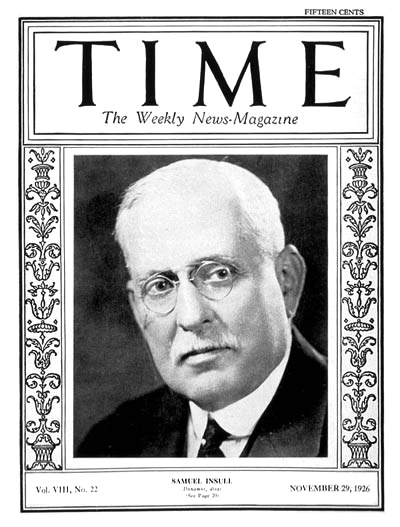
Time magazine, Volume 8 Issue 22, November 29, 1926. Front cover is a photograph of Samuel Insull. Public domain.
Insull’s campaign drew on the perceived success of private enterprise in another network industry: railroads. In both “natural monopoly” industries, a public utility commission grants a utility an exclusive service territory. In exchange, the commission ensures that the utility’s customer base includes not only the valuable, concentrated pockets of population, but also extends to the comparatively sparse rural areas.
Part and parcel of this “regulatory bargain” is the government’s authority to set a reasonable rate of return on the capital investments made by the utility. Paradoxically, commissions attempt to set the utility’s return at a level reflective of what an analogous private enterprise would command on the free market. In the electricity industry, the American ideal of free enterprise persists even in its absence and, much like the real thing, is dominated by its most well-resourced players.
For much of the twentieth century, that bargain appeared workable because utility and public objectives often moved in the same direction. Utilities wanted to build more wires, spend more capital, and collect more of the guaranteed profit that flowed from those investments. The public, meanwhile, wanted a more thoroughly networked grid capable of bringing electric service to homes, farms, and industries across the country. As the backbone of the grid expanded, the public continued to enjoy the utilities’ economies of scale. In that world, commission oversight could look less like regulatory control than supervised expansion: utilities proposed, commissions reviewed, and ratepayers financed a grid that became more useful with each new connection. Insull’s companies predictably flourished.
In the Finger Lakes, another electricity leader, Howard Hopson, would build an empire of his own in the form of the Associated Gas and Electric Company (AG&E). AG&E emulated Insull’s corporate structure and served as its principal rival to the east. Drawing on his experience as a former utility regulator, Hopson famously boasted that the only laws he could not get around were those he wrote. His command of the industry was undeniable, and AG&E grew to cover a formidable territory, in part through its acquisition of Rochester Gas and Electric and Ithaca Gas and Electric, two major players in the early Upstate New York electricity business.
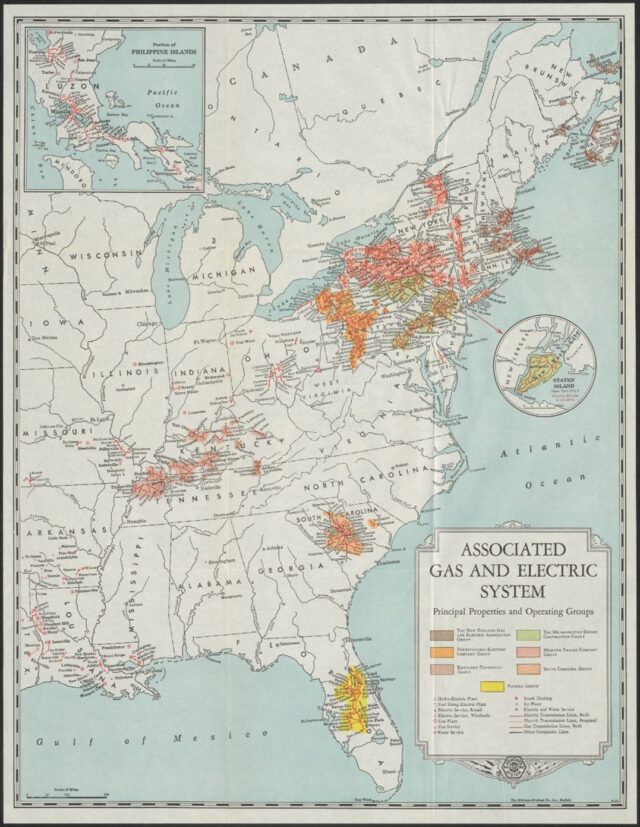
One of Howard Hopson’s promotional maps showing Associated Gas & Electric service territory in 1932. The Whiting-Graham Company Inc. Retrieved with permission of Cornell University – PJ Mode Collection of Persuasive Cartography
But the regulatory bargain’s first signs of weakness became apparent when the economy started to slow. Insull’s and Hopson’s power trusts were organized around a holding-company model that facilitated mergers and acquisitions without much regard for geographic coherence or local accountability. The structure worked something like this: investors controlled a parent company that held controlling shares in a subsidiary utility. That subsidiary could then own controlling shares in another utility, and that utility could do the same again. Each layer allowed control to be extended downward without requiring full ownership at every level. Through this pyramid, a relatively small investment at the top could command a sprawling empire of local utilities below.
This model, however, relies on subsidiaries’ ability to generate sufficient profits to service their parent company’s debt, a relationship also repeated hundreds of times across hundreds of shells and small utilities. When the economy began to slow and holding companies’ dividends dried up, so too did the parent companies’ financial health. The utility empires came crumbling down, catalyzing the Great Depression and taking much of the country’s collective savings down with them.
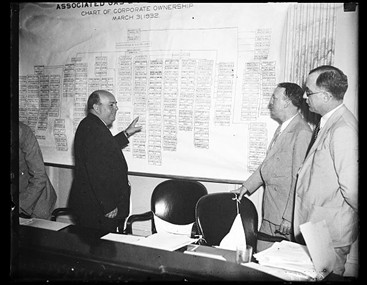
Howard Hopson explains AG&E set-up to Senate Lobby Investigating Committee. Aug. 20, 1935. Public domain.
While Insull would ultimately be acquitted of any wrongdoing, Hopson was not so fortunate. In 1940, Hopson was indicted for fraudulently misrepresenting his companies’ financial health to shareholders. In addition, Hopson’s public boasts helped provide the impetus for a legislative solution that sought to prevent the recurrence of the holding company structure that catalyzed the country’s demise. Congress passed the Public Utility Holding Company Act (“PUHCA”) in 1935 to force utilities to divest assets located in noncontiguous service territories. In other words, the purported efficiencies of utility mergers and holding companies would be permitted only when some presumption of geographic efficiency could be established.
Although PUHCA was written in the language of financial regulation, its animating logic was accountability. Congress recognized that when local utilities were buried inside sprawling corporate empires, regulators and ratepayers could lose sight of who controlled the system, how money moved through it, and whether the public was receiving what it paid for.
With more than a quarter of American households classified as having a high energy burden, it is hard to justify carrying the status quo regulatory scheme into an undertaking as colossal as the clean energy transition.
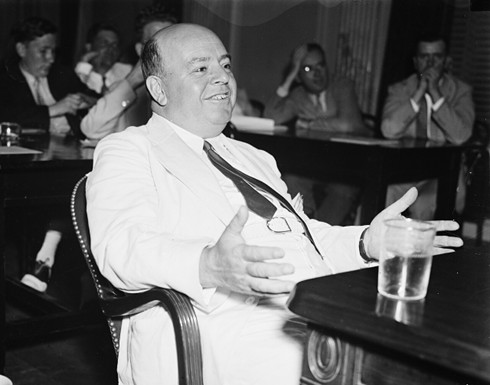
Howard C. Hopson five years before his indictment. Senate lobby, Aug. 14, 1935. Public domain.
PUHCA was supposed to have solved, or at least contained, the accountability problem that sprawling holding-company empires exposed. By limiting utilities’ corporate families to contiguous service territories, PUHCA helped keep responsibility for a utility system closer to the system itself. But over time, PUHCA was weakened, criticized as outdated, and eventually repealed by the Energy Policy Act of 2005. In its place, Congress left a lighter-touch regime that shifted more responsibility to general merger review. The result was predictable: utility consolidation accelerated, and the old accountability problem has returned in modern form. That is the legal opening through which Iberdrola acquired NYSEG and RG&E, folding the two Upstate New York utilities into a multinational corporate family.
That return comes at precisely the wrong moment. With more than a quarter of American households classified as having a high energy burden, it is hard to justify carrying the status quo regulatory scheme, intensified by the return of the power trusts, into an undertaking as colossal as the clean energy transition.
3. Investor-Owned Utilities’ Profit Motive
The dominant corporate form in America elevates the interests of shareholders above all else. Utilities, despite the unique place they hold in the economy, tend also to be shareholder-driven enterprises. Seventy-five percent of American households are served by these so-called investor-owned utilities. While these utilities’ ownership structure intuitively creates a profit incentive, it can be difficult to appreciate how that incentive shapes investor-owned utilities’ behavior without knowing something more. So, let’s take a look at something more: the method utility regulators use to decide how much money utilities may collect from ratepayers. Before we turn to the admittedly dense details of ratemaking, I offer the following words for motivation:
The details of [public utility] ratemaking, [Richard White] observed, [are] ‘exactly the kind of issues that make the eyes glaze and the mind wander.’ But, as White noted, these boring, bureaucratic procedures were often where power was exercised: ‘In a democracy boredom works for bureaucracies and corporations as smell works for a skunk. It keeps danger away. Power does not have to be exercised behind the scenes. It can be open. The audience is asleep. The modern world is forged amidst our inattention.
Congress recognized that when local utilities were buried inside sprawling corporate empires, regulators and ratepayers could lose sight of who controlled the system, how money moved through it, and whether the public was receiving what it paid for.
Ratemaking typically occurs through a proceeding called a rate case. In a rate case, regulators decide how much revenue a utility may collect from customers. The industry refers to this amount as the “revenue requirement.” The phrase sounds almost inevitable. But the revenue requirement is no requirement at all; it is better understood as an investment benchmark. It is designed to cover the utility’s ordinary operating expenses, repay the costs of long-lived infrastructure, and provide a return the regulator deems sufficient to keep investors coming back for more. The revenue requirement, crucially, is shaped by the amount of investment a regulator seeks to encourage.
It’s worth noting the subjectivity involved in setting that return, otherwise known as the return on equity (ROE). Former utility regulator Mark Ellis has argued that the average ROE utilities extract from ratepayers is far greater than actually necessary to incentivize capital investment in the industry. Where the industry benchmark commands a healthy 9.6% ROE, Ellis estimates that their expected returns, given the far greater stability enjoyed by regulated monopolies, should fall around 6.7%. In other words, Ellis claims that regulators are not properly adjusting for risk when attempting to replicate free market shareholder returns in rate cases.
Another important rate case exercise is discerning which expenditures the utility may merely recover and expenditures on which it may earn a profit (the size of which is largely determined by the regulator-authorized ROE). Ordinary operating expenses are generally recovered dollar-for-dollar. Payroll, maintenance, administrative costs, and other recurring expenses may be necessary to operate the grid, but they do not provide shareholders with an opportunity to profit. Capital investments are different. When a utility builds long-lived infrastructure—poles, wires, substations, and other physical assets—it may ask regulators to place those investments into its “rate base.” If regulators agree, customers pay not only to recover the cost of the asset over time, but also to provide the utility with an authorized return on that investment.
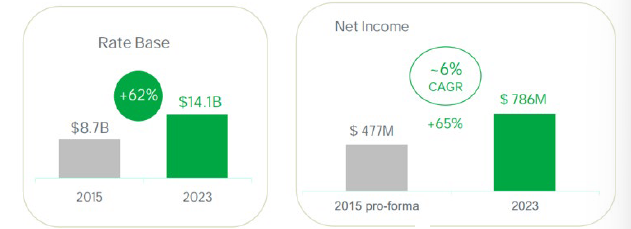
Avangrid’s rate base and net income change from 2015 to 2023. Published in the Northstar audit.
Regulators do not accept every proposed capital investment into the rate base. For a utility to earn a return, the asset generally must be prudently incurred and actually “used and useful” to the ratepaying public. Prudence review, however, is an imperfect tool. Regulators are real people with real resource constraints, asked to evaluate incredibly complex evidentiary records on timelines largely structured by the utility’s filing and based on information supplied mostly by the utility. Faced with these constraints, prudence review becomes less a searching inquiry into utility planning than a retrospective screen for plainly unreasonable spending. It’s important to understand that a “prudent” investment, as specified in a rate case, need not be the cheapest investment or the best investment. Regulators are not certifying that utility spending is optimal. They are using scarce administrative resources to determine whether utility spending clears a relatively forgiving bar.
The regulatory scheme therefore creates a gravitational pull at the center of utility operations: the utility earns by building, not by avoiding the need to build. When a utility solves a grid problem with new capital infrastructure that is at least plausibly prudent, shareholders profit. When it solves the same problem through conservation, utilization of existing assets, or other operational measures, shareholders do not profit. The regulatory system does not merely compensate utilities for serving the public. It nudges them toward a particular way of serving the public: build more infrastructure, add it to the rate base, and earn a return.
Ratemaking also ties the revenue a utility can earn to consumers’ electricity consumption. Rates are set using forecasts of how much electricity customers will consume in a future test year. If customers consume less electricity than expected, the utility may recover less than anticipated; if customers consume more, it may recover more. That link gives utilities another reason to resist conservation, energy efficiency, and distributed alternatives, even when those alternatives served the public interest.
So long as investor-owned utilities retain control over grid planning and a profit incentive to build, even a diminished one, it is inevitable that they will shape the grid in the image of their financial interests.
So, what have we learned? Utilities are incentivized to favor the kinds of spending that regulators allow them to recover with a return. They are especially incentivized to favor physical infrastructure over operational or conservation-based alternatives. And, at least under traditional ratemaking, they have reason to prefer a world in which customers continue consuming enough electricity to support the revenue forecasts embedded in their rates.
Regulators are not insensitive to the risk that utilities will shape their behavior to realize their profit incentives. Indeed, the already complicated rate case of the past pales in comparison to today’s, in part because regulators have attempted to address these problems. So-called revenue-decoupling mechanisms seek to sever utility financial performance from sales volume. Performance-based regulation attempts to tie utility compensation to the achievement of public goals rather than mere capital deployment. These reforms may help. But they do not fully address the structural problem present here. So long as investor-owned utilities retain control over grid planning and a profit incentive to build, even a diminished one, it is inevitable that they will shape the grid in the image of their financial interests.
Professors Mark Lemley and Lawrence Lessig expressed a similar structural concern in the context of telecommunications utilities:
An architecture that maximizes the opportunity for innovation maximizes innovation. An architecture that creates powerful strategic actors with control over the network and what can connect to it threatens innovation. These strategic actors might choose to behave in a procompetitive manner; there is no guarantee that they will interfere to stifle innovation. But without competition or regulation to restrict them, we should not assume that they will somehow decide to act in the public interest.
The attentive reader will notice that Professors Lemley and Lessig suggest that regulation may be an adequate response to these architectural concerns. But that proposition does not survive an encounter with the electricity sector’s experience.
4. Energy’s Public Option
Public ownership is not an exotic alternative to America’s investor-dominated electricity system. Even though the private option championed by Samuel Insull would come to dominate the industry, it was not always clear that private utilities would prevail. Municipal utilities—“munis”—posed an early and existential threat to the for-profit model.
That threat flowed from basic differences in corporate form. Munis do not need to generate profits for private investors. They can access lower-cost capital through bonds. And because they are owned by the communities they serve, their institutional purpose is not to maximize shareholder value but to provide reliable service at reasonable rates. In the early electricity industry, that made munis powerful competitors. They showed customers, regulators, and politicians that private ownership was not the only way to build and operate an electric system.
Insull understood that threat. His argument for government-regulated monopoly was not merely a technocratic response to duplicative wires. It was also a way to preserve private ownership in the face of potential municipal competition. In that sense, the regulatory bargain helped private utilities escape, at least temporarily, the discipline of the public option. Rather than compete against low-cost public systems, investor-owned utilities could submit to commission oversight and preserve the profit-making structure that municipal ownership threatened. Communities retained the ability to operate a municipal utility, but until they affirmatively professed their intent to displace government regulation, an investor-owned monopoly would be protected from all forms of competition.
President Franklin Delano Roosevelt understood the same dynamic from the opposite direction. To him, public power was not merely another form of ownership. It was a yardstick—a public benchmark against which private utilities could be measured. In a 1932 campaign speech, Roosevelt defended the value of publicly owned utilities against the “Insull monstrosity,” a reference to Insull’s holding company propagations. FDR described municipal ownership in terms that remain central to the public-power tradition:
[T]he very fact that a community can, by vote of the electorate, create a yardstick of its own, will, in most cases, guarantee good service and low rates to its population. I might call the right of the people to own and operate their own utility something like this: a “birch rod” in the cupboard to be taken out and used only when the “child” gets beyond the point where a mere scolding does no good.
His metaphor has aged poorly. The institutional insight has not.
![Illustration shows Father Knickerbocker, a symbolic figure for New York City, holding a large stick labeled "Municipal Ownership" at his side, confronting three animated figures labeled "Electric Light Monopoly, Telephone Trust, [and] Gas Trust".](https://theflaw.org/wp-content/uploads/2026/06/King_11.png)
Father Knickerbocker, a symbolic figure for New York City, holding a large stick labeled “Municipal Ownership” at his side, confronting three animated figures labeled “Electric Light Monopoly, Telephone Trust, [and] Gas Trust.” J. S. Pughe, 1905. Public domain.
That checking function remains relevant today. A study by Lawrence Berkeley National Laboratory found that investor-owned utility rates rose 2.7 cents per kilowatt-hour in nominal dollars from 2019 to 2023. Over the same period, municipal utility rates rose only 1.2 cents per kilowatt-hour. And just as in the early days of the industry, the corporate architecture of a municipal utility helps explain the discrepancy.
5. Charting a Path Forward
The grid is getting a makeover. The Edison Electric Institute (“EEI”), a trade association for investor-owned utilities succeeding NELA, projects that its members will spend $1.1 trillion on capital expenditures from 2025 to 2029. That’s an awful lot of shareholder profit. But not all of that spending is unwise. Indeed, if we are to meet the growing demand from electric vehicles, artificial intelligence, and large-scale electrification, much of it is necessary. The question, therefore, is not whether the grid must change. It will and it must. The question is whether our modern grid will be built with communities or shareholders in mind.
So, let’s revisit Samuel Insull’s assumptions to decide for ourselves whether a grid built around them still works for us. First, that electricity should be generated centrally and delivered outward through an ever-expanding network of wires. One of the primary justifications for the centralized power plant model was the relative inefficiency of distributed generation assets. Centralized plants achieved economies of scale that were simply far cheaper and more reliable than the distributed dynamos installed by early adopters of electric lights. And sprawling wires were necessary to ensure that generating capacity had enough pathways to reach customers and make full use of electricity as it was generated. A common refrain in the early days of electricity lamented the unavailability of useful energy storage. Accordingly, sprawling bulk power systems were a necessary addition to the country’s landscape.
Today, distributed energy resources (DERs) like rooftop solar and residential batteries increasingly challenge that centralization model. While we are unlikely to abandon the bulk power system anytime soon, the proliferation of DERs has shifted the balance. More of a community’s energy can be generated from within, rather than from hulking, often polluting, central power plants hundreds of miles away.
By investing in DERs, a community can take charge of its energy future. Cheap energy, as Insull presciently understood, changes lives. A local government increasingly has the power to direct low-cost energy where its community needs it most, a wealth-building paradigm we are only beginning to appreciate. Community solar installations, a form of electricity cooperative, are also a growing phenomenon independent of the DEU model. Together, DEUs can facilitate community solar options that equitably distribute ownership, perhaps according to income or need. This enables local government to add an energy tool to its economic development toolbox.
Insull’s second assumption was that private investors should own and operate that network, subject to regulatory oversight. The energy affordability crisis throws this deeply embedded assumption into question. Communities in New York and elsewhere are beginning to explore whether municipalization, FDR’s “birch rod,” makes sense for them. Investor-owned utilities have spent decades arguing that it does not. Experience has shown that obfuscated asset valuations and embroiled legal controversies await any community seeking to liberate itself from its local monopoly.
Take Pine Tree Utility in Maine, for instance. There, a grassroots movement threatened to overtake another Avangrid subsidiary, Central Maine Power. That is, it was a threat until the utility’s propaganda machine, honed a century earlier, kicked into high gear. The years-long municipalization campaign failed, but only after Avangrid outspent muni advocates 40-to-1.
As a brief aside, consider the absurdity of a system that not only embraces a utility’s vigorous lobbying and public relations campaigns but also allows the utility to recover those expenses from the ratepayers trying to leave. Only some states have begun to remove such expenses from recoverable operating expenses in rate cases.
But even in those states, municipalization is not without roadblocks. A full municipalization effort can require local governments to shell out over a million dollars just to attempt to value the utility’s assets for condemnation. But wait, you ask, doesn’t the utility have that information at the ready for its next rate case? It surely does. But that information is proprietary, thank you. Never mind that this is a company that is, by definition, without competition. Once a community has tallied up the assets, its troubles are not over. The price tag on those collective assets can run into the billions. Despite the fact that those costs are likely outweighed by the public benefits that accrue over the life of the municipalization debt, the sticker shock of billions of dollars can dissuade even the most courageous local officials.
A more modest alternative has emerged that casts doubt on both of Insull’s assumptions at once. Under the distributed energy utility (DEU) model, municipalities leave their incumbent ‘wires’ utility in place. Local governments can then build, own, and operate distributed energy resources alongside the incumbent utility. Because a DEU does not require condemnation of utility assets, the model can be implemented far more swiftly and can therefore lower rates in the short term.
The point is not simply that municipalities can build distributed resources. It is that public institutions can build different distributed resources according to their community’s needs.
The DEU model is largely untested, but Ann Arbor, Michigan, is starting to launch one of the country’s first. And, for those undeterred by the sticker shock of full municipal buyout, the DEU can lay the foundation for those larger municipalization efforts. By starting small and building up institutional muscle, the DEU provides public power advocates with a home for their incumbent’s assets.
To be clear, where a DEU forms, incumbent utilities remain responsible for maintaining the physical distribution network. But municipalities would no longer be confined to the role of passive ratepayer or frustrated complainant. They would be architects. Imagine a local government deciding to build community solar arrays on schools, public buildings, brownfields, parking lots, and farms. Community batteries to reduce peak demand and provide resilience during outages. Municipally funded rebates for energy-efficient appliances in low- and moderate-income housing. Energy planning, meet urban planning.
The point is not simply that municipalities can build distributed resources. It is that public institutions can build different distributed resources according to their community’s needs. And those needs can flow from community voices that too often fall on apathetic ears in state public utility commissions and corporate boardrooms. Instead of seeing the grid through systemwide capital plans and opportunities to place assets in utilities’ rate base, a DEU would begin somewhere else: the community.
That also means the DEU model, like democracy, will not look the same everywhere. Two Upstate New York communities offer a particularly edifying example. Rochester and Cayuga County are served predominantly by RG&E and NYSEG, respectively. Their investor-owned utilities are linked by shared corporate governance, planning failures, and customer-service complaints. But they are not the same place, and they do not face the same energy future.
Rochester is a postindustrial city where energy poverty makes affordability the threshold and final question. Rochester’s DEU would likely begin with low- and moderate-income households. Chief among them are households in neighborhoods where redlining and disinvestment produced wealth inequities that persist today. That energy strategy might also prioritize installing DERs in neighborhoods most exposed to shutoffs and rate shock.
Beyond providing low-cost local energy, community DERs could become vehicles for broader wealth-building programs. A community DER installation could be a vehicle for the guaranteed basic income program Rochester has struggled to fund in recent years. Partial shares in community solar or community energy storage installations could be granted as a public entitlement for qualified households. Creative capital spending can accordingly open new avenues to build community wealth where appropriations are too tight for a big, new social program.
In Cayuga County, a DEU would likely take a different form. There, the transition must contend not only with affordability but also with rural identity. Rural communities are often asked to host the land-use burdens of decarbonization for the benefit of distant load centers. The answer should not be to abandon renewable development, but to let rural communities shape it. Agrisolar projects and locally governed community energy programs could preserve the county’s agricultural character while allowing residents to share in the benefits of the infrastructure they host. Small family farms losing the fight to Big Ag can “harvest” solar on behalf of their neighbors by granting the municipality a lease to their land. And, with thoughtful planning, those solar panels can boost milk production, increase crop yields, and even serve as the foundation for diverse pollinator species and beekeeping operations.

Dual-use agriculture and solar. Retrieved from Wikimedia Commons.
If the next trillion dollars is planned through the same shareholder-driven institutions that produced the present affordability crisis, the transition may decarbonize the grid, but it will not democratize it.
DEUs are not a call to abandon public utility regulation. Nor are they a claim that public ownership cures all ills. DEUs, like any government operation, require thoughtful governance, transparent accounting, and meaningful public participation. But those are design problems, not reasons for surrender.
The clean energy transition will require enormous investment. But investment alone is not a vision. If the next trillion dollars is planned through the same shareholder-driven institutions that produced the present affordability crisis, the transition may decarbonize the grid, but it will not democratize it. Communities will still be asked to pay for decisions made elsewhere. They will still be told that higher bills are the unavoidable price of progress. And they will still lack the institutional power to ask whether a different grid could have been built for them.
Conclusion
The grid of today is not the grid of our great-grandparents, but too much of its governance still is. Insull’s innovations—centralized generation and investor-owned monopolies—helped build the twentieth-century electric system. They should not dictate the twenty-first. Distributed energy resources can already lower costs and reshape the grid today. But technology alone will not determine whether those tools serve the communities asked to host and pay for them. That is a governance choice.
It is about time we rediscovered the principle municipal utilities have long represented: that communities need not remain captive to private institutions when the service at stake is essential to public life. Some communities may choose full municipalization; others may choose a more tailored public option suited to their needs.
We may disagree on the grid’s ideal mix of technologies, markets, and regulations. But we should be the ones making those choices. Inertia is a powerful force. It has led us to accept a system in which the institutions planning an essential public resource are legally obligated to prioritize shareholders over the communities they serve. Yes, inertia is powerful. So too are well-resourced incumbents. But so are the people. So is democracy. We are responsible for building our future, and that future is crying out for an electric utility closer to the people it serves.